John Gresham Machen Quotes
The Christian cannot be satisfied so long as any human activity is either opposed to Christianity or out of connection with Christianity. Christianity must pervade not merely all nations but also all of human thought.
Machen, J. Gresham. "Christianity and Culture." Princeton Theological Review, vol. 11, no. 1, 1913, p. 6.


Keyes was an extreme fundamentalist Christian. Obama was also a religious question but his version of Christianity was not as rigid and extreme as that of Keyes, who was able to determine exactly how Jesus Christ would have voted on every bill before the senate. Obama did not vote for a Constitutional amendment to ban gay marriage and he supported the right of a woman to control her own body and have an abortion of she so decided. Obama won in a landslide including getting the vast majority of the religious vote. Keyes maintained that he had not attacked Obama for his own behavior but for the behavior he voted to enable.


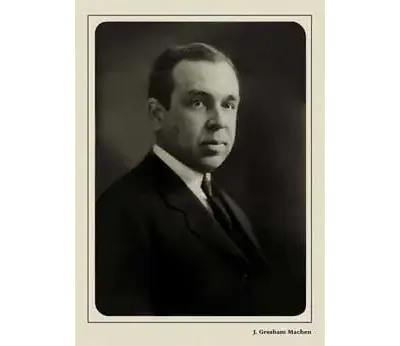
John Gresham Machen (/ˈɡrɛsəm ˈmeɪtʃən/; 1881–1937) was an American Presbyterian New Testament scholar and educator in the early 20th century. He was the Professor of New Testament at Princeton Seminary between 1906 and 1929, and led a conservative revolt against modernist theology at Princeton and formed Westminster Theological Seminary as a more orthodox alternative. As the Northern Presbyterian Church continued to reject conservative attempts to enforce faithfulness to the Westminster Confession, Machen led a small group of conservatives out of the church to form the Orthodox Presbyterian Church. When the northern Presbyterian church (PCUSA) rejected his arguments during the mid-1920s and decided to reorganize Princeton Seminary to create a liberal school, Machen took the lead in founding Westminster Seminary in Philadelphia (1929) where he taught New Testament until his death. His continued opposition during the 1930s to liberalism in his denomination's foreign missions agencies led to the creation of a new organization, the Independent Board for Presbyterian Foreign Missions (1933). The trial, conviction and suspension from the ministry of Independent Board members, including Machen, in 1935 and 1936 provided the rationale for the formation in 1936 of the OPC.
