Hisham Matar Quotes
The Arab Spring, with all of its failings and failures, exposed the lie that if we are to live, then we must live as slaves. It was an attempt to undermine not only the orthodoxy of dictatorship but also an international political orthodoxy where every activity must be approved by the profit logic of the 'ledger.'
Matar, Hisham. "Libya's Relentless Revolution." The New York Times, 2011.

Those who have fought against dictatorial governments for their basic human rights, found after victory and the overthrow of the dictator, that there was another force fighting for control which would deny citizens human rights based on a theocracy. They wanted the end of the dictator so they could use their interpretation of a religion as the excuse to deny all citizens basic human rights.


This was one of the first calls for a slave strike in America.


Southerners complained that abolitionists were advocating revolution. While most did not, some did advocate mass rebellion. The fact that Remond was himself a Black, created even more distress to the South.


This fear was great among many who were abolitionists as potentially there might be mass slaughter of all Southern whites.


This is a very important quotation because it illustrates a characteristic of most South American (and many other world) cultures. Namely, that respect and dignity are more important than freedom. There is even a Spanish term conveying the importance of respect: Respecto! This is very different from the Anglo-American tradition where if one has freedom, he is little concerned with what others think of him, and no amount of respect would offset the loss of freedom. The person who is free, has the dignity that he needs. The importance of respect over freedom was also a major characteristic of European Fascism in the 1930s.

The slogan was made famous by James Larkin, 1875–1947, Irish trade union leader who used it frequently and whose memorial statue in Dublin contains the quotation in French, English and Irish.

This quotation is historically important because Davis clearly states the reason for the rebellion of the South. The anti-slave states were growing at a greater rate than the slave states and despite the greater voting power that a southerner had (a result of the 3/5 count of slaves for census purposes, and the Senate), the handwriting was on the wall and the majority of the United States was against the vicious institution of slavery and would make it unprofitable, impossible and/or illegal in the coming years. Southern slavery advocates saw this as a “tyranny of the majority” and therefore took up arms. In the early 20th century, apologists for the Southern rebellion tried to promote the idea that there were reasons other than slavery, but this quotation and the resolutions of the states who withdrew from the Union make it clear that the right to maintain slavery was the only significant issue. In that sense it was a States’ Rights issue, but the South was opposed to States’ Rights when it came to States refusing to return fugitive slaves when Federal Law required such under the Dred Scott Supreme Court Decision.

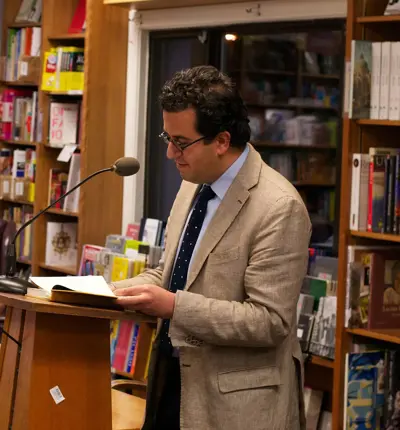
Hisham Matar (Arabic: هشام مطر) (born 1970) is an American born British-Libyan writer. His memoir of the search for his father, The Return, won the 2017 Pulitzer Prize for Biography or Autobiography and the 2017 PEN America Jean Stein Book Award. His debut novel In the Country of Men was shortlisted for the 2006 Man Booker Prize. Matar's essays have appeared in the Asharq al-Awsat, The Independent, The Guardian, The Times and The New York Times. His second novel, Anatomy of a Disappearance, was published to wide acclaim on 3 March 2011. He lives and writes in London.
