Henry A. Kissinger Quotes
The American foreign policy trauma of the sixties and seventies was caused by applying valid principles to unsuitable conditions.
Kissinger, Henry. White House Years. Little, Brown and Company, 1979, p. 64.


The memorandum articulating the new proposed policy is referred to as “the containment memo.”


During the Cold War and afterwards many Americans attributed the problems we were having with the Soviet Union emenated from the fact that they were Communists, and our focus was anti-communism. Kennen, however argued that it was not Communism that was the cause of the Aggression of the Soviet Union. It was an extension of the Russian Culture. After the Soviet Union collapsed, and Communism was rejected by the Russians, we still had a great deal of Russian aggression and Foreign Policy problems with Russia. Kennan was right. It was the Russian culture, history, values and traditions that were the primary cause of most of the problems with Russia.


President Johnson had invited Ike to the White House to advise about the Vietnam War in general and the Rolling Thunder operation in particular. President Eisenhower’s quotation was one of the clearest statements of the so-called Domino Theory which was believed by almost all American Military and Foreign Policy leaders. It was tragically wrong, but it drove U. S. policy throughout the war. When the Communists took South Vietnam, there was no subsequent Communist takeover or attempt in any of the countries Eisenhower had enumerated. One of the reasons was that the Vietnam Communists were not very close to the Russians and for over 1000 years had considered China their worst enemy. They had little solidarity with the International communist movement, but American intelligence did not realize that. They did not believe that the ethnic hatred between Vietnam and China would inhibit the Vietnamese in modern times. It did. Even after the war, the Vietnamese developed better relations with the U. S. then they had with China. One of the major things the intelligence and policy operators missed was that there was not a single map in China that showed Vietnam as a country. To the Chinese, it has always been a part of China and they want it to be in the future. The Vietnamese have not agreed for a millennium.
The reference to Munich referred to British Prime Minister meeting with Adolf Hitler in Munich, giving Germany some of their demands while receiving assurances that there would be no further aggression. This appeasement just encouraged Hitler to take more and soon he had invaded all of Europe beginning World War II. The view since has been that a dictator must never be appeased in unjust aggression, even on relatively small items. What made the Vietnam War so complicated was that while it appeared that the attacks on South Vietnam by Communist North Vietnam was a first step of general Communist Aggression, the reality was that it was primarily a Civil War where the South was a massively corrupt, Catholic Controlled dictatorship and the North was a Communist dictatorship dominated by Buddhists. And there was major friction between the Vietnamese Communists and the Chinese Communists who were not working in concert for general Communist domination. The North Vietnamese were a nationalist movement. The Domino Theory had been wrong.


Most socialists in American and elsewhere initially supported the United States policy of intervention in the Vietnamese civil war. While they disapproved of much of the general economic policy, the Russian, Chinese and other Communist trampling on human rights seemed like a worse alternative.

Ironically, at the time she wrote this column, Mrs. Roosevelt was being accused of being a communist by some Southerners who associated her strong views against racism and segregation. Some in the North thought she was a communist because of her active role in the New Deal, Yet here she was, willing to use military force to prevent Soviet expansion.
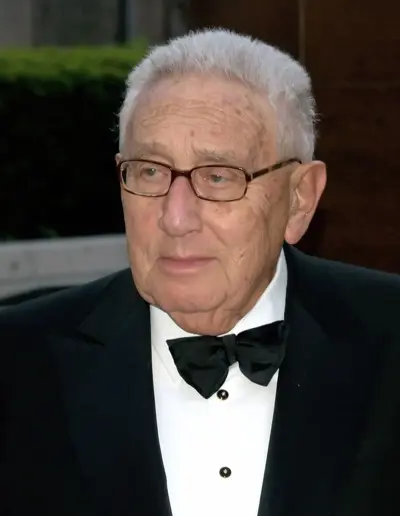
Henry Alfred Kissinger KCMG is an American politician, diplomat, and geopolitical consultant who served as United States Secretary of State and National Security Advisor under the presidential administrations of Richard Nixon and Gerald Ford. A Jewish refugee who fled Nazi Germany with his family in 1938, he became National Security Advisor in 1969 and U.S. Secretary of State in 1973. For his actions negotiating a ceasefire in Vietnam, Kissinger received the 1973 Nobel Peace Prize under controversial circumstances, with two members of the committee resigning in protest.
