Winston Churchill Quotes
That’s right Clement. Every time you see something big, you want to nationalize it.
Churchill detested Attlee both personally and for his political philosophy which was left wing especially favoring government nationalization of all large industry and business. Churchill walked into the very large men’s room and saw Attlee at a urinal and one end. Churchill, setting Attlee up, walked all the way to the other end of the row of urinals and began to use one there. Attlee commented that Churchill was appearing very standoffish to be urinating so far away. Churchill, then let loose with this repartee. See {620650} for another put down of Attlee.
Winston Churchill, 1874-1965, British Prime Minister (Conservative), Response to Clement Attlee in a men’s bathroom of the House of Commons
Sourced by: Eigen's Political and Historical Quotations

Churchill detested Attlee, politically and personally. Atlee had an important government post with the quaint English title of “Lord Privy Seal.” In this spontaneous response, Churchill, insulted both Atlee and his position. See {620649} for another put down of Attlee
Churchill and Labor Leader Clement Attlee found themselves at adjoining urinals during a break in a political event.

1st Viscount Snowden. Nationalization is when a nation or state determines that certain industries of areas of the economy should be reserved for the government to operate. Private companies, if they have been operating a nationalized industry losse their rights to continue in that business and may even lose their physica assets in which case th form is supposed to be paid a fair price. In 21st century America we have very few nationalized industries. One of these is the manufacture of nuclear weapons. Communist counties have many if not most of the economy nationalized. From the 19th century socialism has evolved from a belief that most people will best be served by nationalization of most of th major economic functions. However, over time this did not meet Socialism’s other objectives and nationalism became less popular with socialists. Snowden, a leading socialist, wanted to get rid of the concept entirely, and today there are very few situations where there are calls for nationalis. Even the few remaining communist nations are privatizing (the opposite of nationalizing) some of their economy.


The first part of this quotation has defined the attitude of most Americans towards private enterprise and government since then. The second part of the quotation—the undesirability of public ownership of railroads has given way to the modern problem that no passenger railroad can be operated profitably by anyone—private or public. So Roosevelt’s “far-reaching disaster” was finally complete with the Federal Government taking over responsibility for Amtrack.

Ironically the far right wing Fascists and the far left wing Communists agreed on this point: nationalization.


While Murphy may have believe this, his company would profit immensely of Chrysler would fail. 28 years later it was General Motors that required the bailout that was much larger than the Chrysler one. The GM executives had gotten over their philosophical objections.


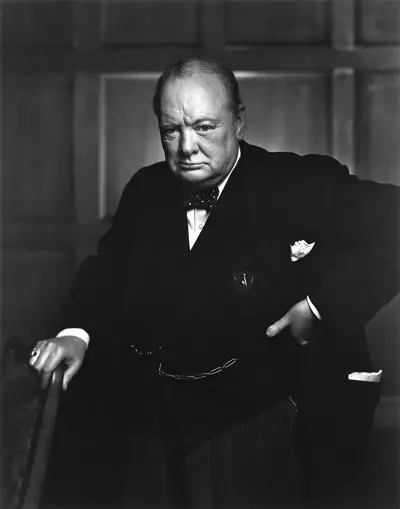
- Born: November 30, 1874
- Died: January 24, 1965
- Nationality: English
- Profession: Statesman
Sir Winston Leonard Spencer Churchill, KG, OM, CH, TD, DL, FRS, RA was the Prime Minister of the United Kingdom from 1940 to 1945, during the Second World War, and again from 1951 to 1955. Apart from two years between 1922 and 1924, Churchill was a Member of Parliament (MP) from 1900 to 1964 and represented a total of five constituencies. Ideologically an economic liberal and imperialist, he was for most of his career a member of the Conservative Party, as leader from 1940 to 1955. He was a member of the Liberal Party from 1904 to 1924. Churchill was also well known for his military career and as a historian, painter and writer, and among his many awards was the Nobel Prize in Literature.
