Noam Chomsky Quotes
South Africa, with US support, after the fall of the Portuguese empire, invaded Angola and Mozambique to establish their own puppet regime there. They were trying to protect Namibia, to protect apartheid, and nobody did much about it; but the Cubans sent forces, and furthermore they sent black soldiers and they defeated a white mercenary army, which not only rescued Angola but it sent a shock throughout the continent-it was a psychic shock-white mercenaries were purported to be invincible, and a black army defeated them and sent them back fleeing into South Africa.
Chomsky, Noam. Hegemony or Survival: America's Quest for Global Dominance. Metropolitan Books, 2003.


The Boer farmers of South Africa invented commando tactics where they would surprise the British, hit and run. It was very effective. Although they could not win the war that way, the prolonged the battle against an overwhelmingly superior force setting an example of asymmetric warfare that lasted hundreds of years. The Sudanese to whom the General referred were the Islamic religious insurgents whom he had soundly defeated the year before in the Sudan. With their religious fervor they attacked en mass and although very courageous were not very effective.

The Boers were lower class, uneducated, farmers from Holland who came to South Africa before the English did. They were at the bottom of the Dutch socioeconomic ladder. Unlike the English who were interest in establishing a trading colony, the Boers just wanted to own and farm the land and use blacks as slave or cheap labor. The Dutch Government and Trading companies lost interest in South Africa as there were much more profitable parts of the world, and they felt no obligation to the Boers whom they were glad to be rid of. So the Boers found themselves having to follow the British laws and rules of the British Colonial Office. Slavery was outlawed, and Blacks could be educated and become citizens under British law. They could own land, and contest the right of the Boers who had settled in some uninhabited land and some that was owned by Black tribes. The Blacks outnumbered the whites in general and the Boers, and there were educated Blacks who “outclassed” the still relatively uneducated Boers. So the Boers, fighting for their “way of life” set up their own area in Southern Africa and claimed independence. But Blacks claimed that it was their land and looked to the British to exercise English law. The Boer war ensued. Although the Boers lost the war, the bred at a much faster rate than the English, many of whom did not even have their families in South Africa. By the end of WWII, the Boer white majority controlled the government and kept the majority Blacks from voting and having full citizenship rights. They dominated Apartheid South Africa until the Black Revolutionists obtained control and although Black and white relations are better in South Africa than most countries, the extemeist Boers and most militant Blacks are in political, but not violent, conflict. Churchill and the British have always perceived themselves as being caught in the middle between the Boers and the Blacks.
If the land to be redistributed is divided amongst the majority population, each parcel would be too small to make any difference in any recipient’s life. For efficient agriculture there must be large land holdings. The colonial, stolen land history is valid for most former colonies, however, in Southern Africa, the situation was more complicated. When the whites landed at Capetown in the South, they moved North “stealing” land as they went. However, in Central Africa, Shaka and his Zulus were also a colonial power, and they moved South “stealing” land from the indigenous Blacks as they went. Eventually, the two Colonial Powers—the whites and the Black Zulus—clashed and the Zulu Wars ensued. So all of the land in Zimbabwe and South Aftica was stolen from the Blacks—except about half was stolen by Blacks. After the Zulu Wars, the victorious whites ended up “stealing” land from the Black Zulus that had been stolen by them from other Blacks. Also although the English were the official colonial power, the Dutch “Afrikaners” were a powerful subculture which was dominant on many parts of South Africa and especially at the frontier and they did most of the land stealing. The ethnic English were the businessmen and the city dwellers who actually ruled that Blacks were citizens with rights and slowedmdown some of the land stealing. There is no more complicated ethnic history in the world.


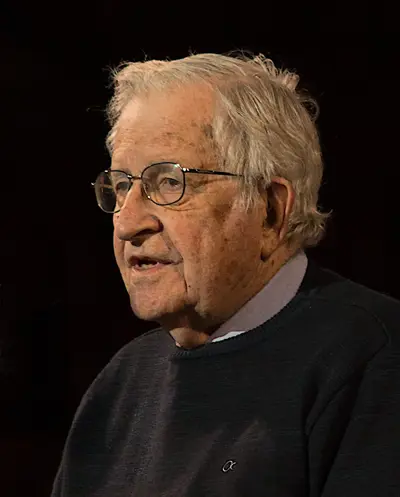
Avram Noam Chomsky is an American linguist, philosopher, cognitive scientist, historian, social critic, and political activist. Sometimes called "the father of modern linguistics", Chomsky is also a major figure in analytic philosophy and one of the founders of the field of cognitive science. He is Laureate Professor of Linguistics at the University of Arizona and Institute Professor Emeritus at the Massachusetts Institute of Technology (MIT), and is the author of more than 150 books on topics such as linguistics, war, politics, and mass media. Ideologically, he aligns with anarcho-syndicalism and libertarian socialism.
