Elizabeth Warren Quotes
Some people say that we can’t afford to help our kids through school by keeping student loan interest rates low. But … the federal government offers far lower interest rates on loans, every single day–they just don’t do it for everyone. Right now, a big bank can get a loan through the Federal Reserve … at a rate of about 0.75%. … a student who is trying to get a loan to go to college will pay almost 7%. … the federal government is going to charge students interest rates that are nine times higher than the rates for the biggest banks–-the same banks that destroyed millions of jobs and nearly broke this economy. That isn’t right.
What made the situation worse at the time that the same big banks who got government bailouts to prevent failure and received the 0.75 percent rate, turned around and lent the money to the students not only charging them 9 times what they paid for the money, but also getting a government guarantee that the loans would be repaid and/or government prohibition of students going bankrupt and discharging their debt like any other American in financial difficulty. So the banks made huge profits and yet took no risk—a strange notion in capitalism.
Elizabeth Warren, Special Assistant to the President (Democrat), U. S. Senator (Democrat, MA), Statement upon introducing her first bill in the Senate, May 10, 2013
Sourced by: Eigen's Political and Historical Quotations

The 7 percent was the interest students had to pay for the Federal Student Loan Program. The banks in contrast were able to obtain money at the Federal Reserve Bank Discount Window at no interest cost. Draut was one of those in the Occupy Wall Street Movement who could not understand why the government provided so much help to the banks relative to that given to students and most other segments of society. Draut, and other protestors, not only thought that the differential favoritism to the banks was unfair, but unjust in the sense that in substantial part the Meltdown of 2008 was the fault of the banks while the students and most of the other elements of American society were the victims. Both the George W. Bush and Obama administrations believed that even though the banks may have been irresponsible and the cause of much of the economic dilemma of the nation, if the banks would be allowed to fail, the Great Recession would have become a major depression and the suffering of the entire country would have been magnified many times, so Wall Street and the banks were bailed out to stave off a much worse economic disaster. It was clearly unfair and unjust, but generally perceived to have been necessary by the politicians and economists.


The Chairman of the Federal Reserve Board, creatively found alternatives that the Fed had never used before and almost all experts did not even realize that were possible. He and Treasury Secretary Paulson, almost certainly saved the American system of capitalism. But in the process, they in the early stages and Bernanke throughout the crisis took a number of steps to save the system where the very people and companies whose actions had triggered the entire crisis seemed to personally benefit while most Americans were hurt badly and none of them received any immediate personal benefits the way the large bankers did. The amount of money that Bernanke and his Federal Reserve Board associates spend was staggeringly large and that too distressed many Americans. Almost all of the money was actually returned to the taxpayers as a result of the work of the Fed and the Treasury officials, but no one could feel good about the unfair disparity that had so benefitted much of Wall Street particularly and Main Street and the rest of American only generally while so many lost their jobs, their homes, their dignity and their hopes. Only the big banks and bankers also got a personal huge windfall of taxpayer money and took no risk for that. The alternative would have ruined everyone and even have been worse for the average citizen.


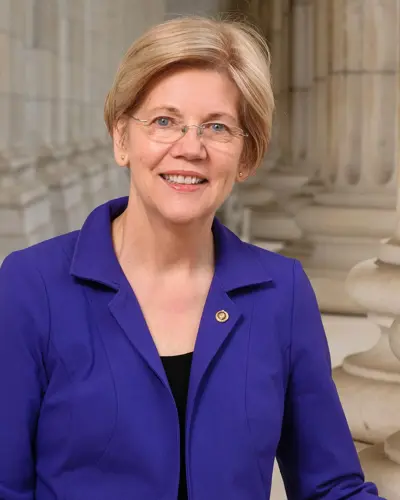
Elizabeth Ann Warren is an American politician and former law professor who is the senior United States senator from Massachusetts, serving since 2013. A member of the Democratic Party and regarded as a progressive, Warren has focused on consumer protection, economic opportunity, and the social safety net while in the Senate. Warren was a candidate in the 2020 Democratic Party presidential primaries, ultimately finishing third.
