Nikita Khrushchev Quotes
Revolutions are not made for export
Nikita Khrushchev, 1894-1971, Soviet Premier, Speech, 21st Annual Communist Party Congress, Moscow, January 27, 1959
Sourced by: Eigen's Political and Historical Quotations

Francisco Ascaso, Buenaventura Durruti, Juan Garcia Oliver, Aurelio Fernandez, Ricardo Sanz, Gregorio Jover, Antonio Ortiz and Antonio Martinez Valencia

Harding, not the most historically knowledgeable of American Presidents, had forgotten the revolutionary origin of the United States or its drastically experimental nature. It was the fear of Communism and the Russian Revolution that gave revolution a bad name at the time.


Khrushchev did not originate this quotation. It was first stated by Lenin. See {620087}.


Germany, after its defeat in WWI was going through massive demonstrations and strikes. The government kept issuing bulletins that “Order Prevails” and the like. Luxemburg’s rhetoric and writing was so damaging to the government that they had her assassinated shortly after this statement.


The attempted putsch failed. Hitler was arrested and jailed 4 days later.

There had been a Chinese Revolution in 1911, but although there were changes at the seat of government and in urban areas, the rural areas where most of the people lived changed little if at all. The revolution failed as a result of it became a revolution without reform.


Because of that conservatism he was murdered by the radical IRA in the internecine Irish revolutionist conflicts that followed the Irish Free State winning its independence.


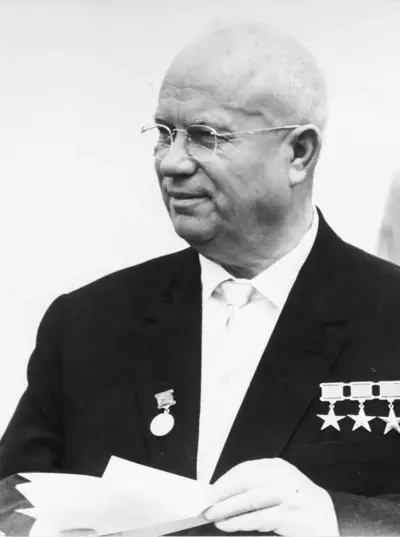
Nikita Sergeyevich Khrushchev led the Soviet Union as the First Secretary of the Communist Party of the Soviet Union from 1953 to 1964 and as chairman of the country's Council of Ministers from 1958 to 1964. During his rule, Khrushchev stunned the communist world with his denunciation of Stalin's crimes and began De-Stalinization. He sponsored the early Soviet space program, and enactment of relatively liberal reforms in domestic policy. After some false starts, and a near-nuclear war over Cuba, he conducted successful negotiations with the United States to reduce Cold War tensions. His proclivity toward recklessness led the Kremlin leadership to strip him from power, replacing him with Leonid Brezhnev as First Secretary and Alexei Kosygin as Premier.
