Oliver P. Smith Quotes
Retreat Hell! We're just attacking in another direction.
This is one of the great examples of putting positive spin on a negative situation.
Oliver P. Smith, Marine Corps General, Statement to the press when asked if he was retreating during the Korean War, December 1950
Sourced by: Eigen's Political and Historical Quotations


The Germans and Americans did this as a standard practice. The French “history” to which the General referred did not involve machine guns and mortars. The entrenching tool (shovel) was a fundamentally important piece of equipment to the Germans and Americans but not the French at the beginning of WWI. Later in the war, the French finally learned.

He was leading the Gordon Highlanders of the British Army against the Boers during the Boer War. He was seriously wounded and could not go on himself with a charge he had ordered, However, waifing his sword he made this famous qutation. Particualrly noteorthy is the derrogatory terms which he used to describe the enemy--the Boers of South Africa. In many wars and cultures, one or more of the combatants, in order to overcome the avarage soldier's reluctance to kill an enemy, characterizes them as less than human. In this case, vermin, who were to be exterminated. There were two predominant groups of whites who came to South Africa, the English who were generally well-educated and were interested in trading with the exhisting inhabitants and investing in businesses using mostly native labot and the Boers. The latter were of Dutch and German origin, poor farmers with little or no land in the home country and little education. Their interest was to create a nation where they could own land to farm. And the lest expensive way for them to increase their farmland was to sieze it from the native Blacks and who were the major forces behind the racial discrimination which became apartheid. The British contolled the government and sought stability and as in most of the British Empire, they wanted English law to prevail including the rights of the Black natives. The Boers had left Europe for good and would thrive or not in Southern Africa. Proportiopnately, the English might have a career in South Africa or serve there for a few years. They were Englishmen in a foreign country. The Boers saw themselves as citizens of Southern Africa who were fighting the native Blacks for control of the land. The English legal system would not allow any of the land seizures and political discrimination that the Boers saw as existential for their survival in Africa. Soon, the Boers took more and more of the law into their own hands and saw English rule and dmination as inimical to their interests in Africa and they tried to create their own independent states in Southern Africa. That was the essense of the Boer Wars. Dick-Cunyngham was awarded the Victoria Cross, the highest military decoration of Great Britain, for his exploits in the Afghan War.


He was a strong believer in surprise attack and preemption.


This was only 10 months into Nixon's Presidency. He stepped up the war.

The Americans were at the bottom of the hill and the Spanish were dug in at the top. They were able to pick the Americans off one by one. Roosevelt was planning on a frontal charge of his Rough Riders and Buffalo Soldiers he was commanding but his fellow officer’s men were in front of them. The officers had no orders to charge the top of the hill and the other officer would not order his men to charge. Led by Roosevelt, his men went through the other troops and charged the hill taking it in the famous Charge Up San Juan Hill (actually Kettle Hill).

Although the two men differed on a very important issue, each admired the other and acquitted themselves politely throughout. Congress explicitly gave the President the powers that he had exercised and won the dispute. But Dixon had also won, and upheld the law as it existed until it was changed.


As an educational and military leader, he saw the importance of each in a nation’s welfare.


Barak was the most decorated soldier in Israeli history.

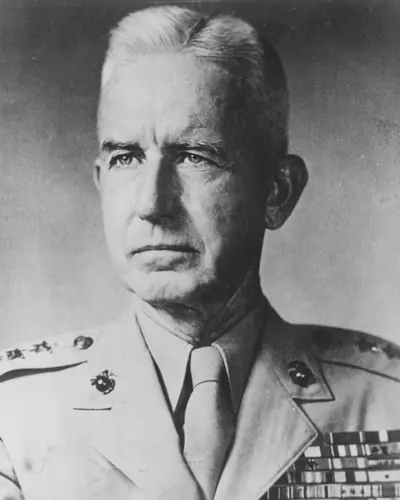
Oliver Prince Smith was a U.S. Marine four star general and decorated combat veteran of World War II and the Korean War. He is most noted for commanding the 1st Marine Division during the Battle of Chosin Reservoir, where he said "Retreat, hell! We're not retreating, we're just advancing in a different direction." He retired at the rank of four-star general, being advanced in rank for having been specially commended for heroism in combat.
