Robert M. La Follette Quotes
[Repudiating communist support:] The Communists have admittedly entered into this political movement not for the purpose of curing, by means of the ballot, the evils which afflict the American people, but only to divide and confuse the Progressive movement and create a condition of chaos favorable to their ultimate aims. Their real purpose is to establish by revolutionary action a dictatorship of the proletariat, which is absolutely repugnant to democratic ideals and to all American aspirations.
Robert M. La Follette, 1855-1925, Governor of Wisconsin (Republican), U.S. Senator (Republican, WI), Presidential Candidate (Progressive), Open letter to U. S. Attorney General Herman Ekern, May 26, 1924
Sourced by: Eigen's Political and Historical Quotations

This was the hope and expectation of many left-wing supporters of the Russian Revolution throughout the world. The dream was never realized until Communist Russia collapsed in the latter years of the 20th century.


In 1927 the Russian Communist Party changed its position regarding the world union movement. Prior to that the Communists would not organize unions competing with already existing trade unions. Foster was one of the communist leaders who was the strongest advocate of this solidarity of the working class. However, after years of preaching one thing, he reversed himself. This type of adherence to party discipline led to him getting a derogatory nickname. See {592421}.


This was only 6 years after the Russian Revolution. Communist Russia had extended its influence to much of the world without firing a shot. To many, communism looked like the future. The Russian inability to make communism work economically in the next 70 years destroyed most of its influence.


When Nixon and Kissinger went to China in the midst of the cold war, there are many American right-wingers who objected and thought that it was a betrayal of America’s fundamental principles At the same time, the extreme left wing, hard line Communists objected for the exact same reasons to China allowing the visit. This quotation is an excellent example of the latter.


The occasion for the speech was the 60th birthday of Russian Premier, Joseph Stalin.


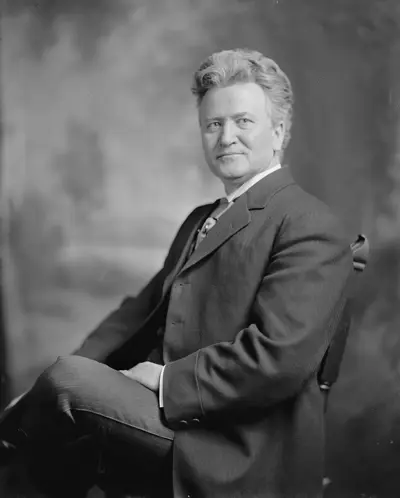
Robert Marion "Fighting Bob" La Follette Sr., was an American lawyer and politician. He represented Wisconsin in both chambers of Congress and served as the Governor of Wisconsin. A Republican for most of his career, he ran for President of the United States as the nominee of his own Progressive Party in the 1924 presidential election. Historian John D. Buenker describes La Follette as "the most celebrated figure in Wisconsin history."
