Anthony James Leggett Quotes
Remember that no piece of honestly conducted research is ever wasted, even if it seems so at the time. Put it away in a drawer, and ten, twenty or thirty years down the road, it will come back and help you in ways you never anticipated.
Anthony James Leggett, Nobel Laureate in Physics, Speech at the Nobel Banquet, December 10, 2003
Sourced by: Eigen's Political and Historical Quotations


Some scientists would use this as an example of what scientific research is really like; others would argue that Ballard, however great as a field scientists and explorer, was a poor basic scientist and theoretician. He tends to work in the softer side of his science. This would be a very unusual occurrence for an experimental physicist or a molecular biologist.


He was one of the team that created the first Atomic Bomb. In 1946, the atomic bomb was known about by almost all Americans and almost no one had even heard of a computer or the concept of a computer. The British and Americans during the war had collaborated to build very limited electronic calculating machines but the concept of programs to control the calculating machines was new—initially created by van Neumann and Englishman Alan Turing. When he made this statement most people thought it was the ravings of a “mad scientist. He was one of the team that later developed the first real computer at the Institute for Advanced Study at Princeton.”


Venter developed an entirely new method of finding new species and hence new genes by collecting water samples from all over the world and using computers to catalog all the life forms and determine whether or not each is new and then isolating the genes if unique. As a very wealthy business man he had a personal sailing yacht which he turned over to graduate students and young scientists who then sailed much of the world taking indiscriminate samples, preserving them and sending them back to Venter’s computer bank for analysis. The cost per gene and specie discovered was amazingly small as it was an industrialization of finding new life forms.
Most environmentalists limit the vision of their solutions to using less of our precious natural resources which is very important but just as important and perhaps more so in the long run is increasing the supply of these resources. Food is an example. The major reason that there is no serious food shortage world-wide is that we have increased the productivity of agriculture requiring less labor, less water, less fertilizer, less land, and less dependency on weather. Distribution has also improved, but there is no very good way of distributing something for which there is a great shortage.

The “gap” is different in different fields. Public health has a particularly large gap while laser app;ications have a much smaller one.

A quantum computer is a radically different kind of computer that uses the physics of Quantum Mechanics—the latest of the large systemic Physics breakthroughs for which there has as yet been very little technology or practical applications. In theory quantum computing will be much more powerful and orders of magnitude faster than existing supercomputers.


This is why the American Government has played such a major role in most of the great technologies in American History. Interchangable Parts (A federal contract with Eli Whitney), Canal Construction (New York State built the Erie Canal), the Railroad (federal government gave hugh tracts of land to build the rail lines to the West), the Telegraph (No one would use it until the government financed the experiment to prove it by creating a line between Baltimore and Washington), AC Electricity, there the city of Rochester NY hired Tessler and Westinghouse to Demonstrate Generating Electricity at Niagra Falls and transmitting it over 20 miles which Edison’s Direct Current could not do), immunization (the Army Medical Corps gave the first grants to universities to develop the science of vaccines and immunization, the computer (in WWII the U. S. financed the development of computers sent to England to implement Turing’s breaking of the German “unbreakable” code), atiomic energy (the Manhattan Project—the largest scientific endeavor the world has known), the Internet (Developed with long term research funds for DARPA the future technology research arm of the Defense Department. American investors and businesspeople took each of these and developed them but the initial steps, when no capitalist dared risk on such basic and futureistic efforts were taken by American Government which probably could never have developed these technologies but the private sector could not do it with government in the role Moritz herein describes.

The French King had paid the cost of the scientific experiment. Royal and Wealthy patrons together with the “sweat equity” of the scientists funded most scientific research until WWII in the 20th century in America. Since then national governments have funded larger and larger proportions of scientific research.

Under this initiative the US declassified and distributed technical, previously secret information, about atomic science to the world for scientific development. It has been very successful and there are few modern nations that have not benefitted from the program.

The Science Guy. Explaining one of the benefits of investing Federal Funds in space research.

He had just published a paper for the American Association for the Advancement of Science reporting on his development of techniques to transplant arteries from one animal to another. This was the beginning of transplantation. However, immediately he envisioned the possibility of transplanting all organs in humans including the heart. It would take half a century for Dr. Christian Barnard to actually transplant a heart, but the idea was not novel. It had been a goal since Flexner made this quotation.
It is not only the companies of rich nations that equip their people, but also the non-profit sector including the universities.
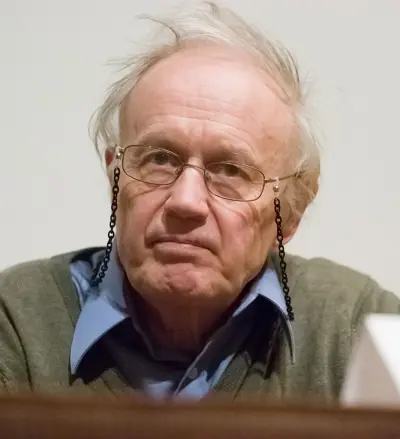
Sir Anthony James Leggett KBE FRS is a theoretical physicist and professor emeritus at the University of Illinois at Urbana-Champaign. Leggett is widely recognised as a world leader in the theory of low-temperature physics, and his pioneering work on superfluidity was recognised by the 2003 Nobel Prize in Physics. He has shaped the theoretical understanding of normal and superfluid helium liquids and strongly coupled superfluids. He set directions for research in the quantum physics of macroscopic dissipative systems and use of condensed systems to test the foundations of quantum mechanics.
