Denis Healey Quotes
[Referring to LBJ:] ... one of the few politicians with whom I found it uncomfortable to be in the same room.
Denis Healey, British Minister of Defense (Labour), Chancellor of the Exchequer, The Time of My Life, 1990
Sourced by: Eigen's Political and Historical Quotations

Asked to comment on the "steadiness" of then incoming president, George W. Bush:


Lyndon Johnson was unhappy with his low popularity and asked some advisors why it was that people didn't seem to like him:


Moyers was also an ordained Baptist Minister. At a White House dinner, Moyers was asked to say grace. He did so in a soft and reverent voice. President Johnson, seated far away, and not hearing Moyers words clearly said in a loud voice, “Speak up, Bill. Speak up.” Moyer’s response followed.

McNickle claimed to have quoted her in an article and she did not say it and she was angry that he had put words in her mouth. Most political spouses would just suffer in silence, and if they did respond would do so in very polite and in the case of women “ladylike: terms. Ms. Kerry however was not only a very successful business woman but also was one of the richest women in America who had been in the tussles of male battles before


Fox hunting was a sport engaged in only by the very wealthy. The House of Lords tends to represent the views and norms of the British upper classes who engage in Fox hunting. Skinner and the House of Commons wanted to ban Fox Hunting because it is a very cruel sport with dozens of dogs chasing a single fox and often tearing him apart before the riders arrive.


He delivered this speech towards the end of the 1st year of President Donals Trump's Administration. Althought he never mentioned Trump by name, this speech was a rare major criticism of a sitting president by a former president. This was also one of the few speeches Bush gave after leaving office. On the same day, former President Barak Obama also gave a major speech and also castigated President Trump although neither of the ex-presidents knew that the other was about to deliver their criticism of Trump. It was one of the very unusal occurances in American history.

He was leading the Gordon Highlanders of the British Army against the Boers during the Boer War. He was seriously wounded and could not go on himself with a charge he had ordered, However, waifing his sword he made this famous qutation. Particualrly noteorthy is the derrogatory terms which he used to describe the enemy--the Boers of South Africa. In many wars and cultures, one or more of the combatants, in order to overcome the avarage soldier's reluctance to kill an enemy, characterizes them as less than human. In this case, vermin, who were to be exterminated. There were two predominant groups of whites who came to South Africa, the English who were generally well-educated and were interested in trading with the exhisting inhabitants and investing in businesses using mostly native labot and the Boers. The latter were of Dutch and German origin, poor farmers with little or no land in the home country and little education. Their interest was to create a nation where they could own land to farm. And the lest expensive way for them to increase their farmland was to sieze it from the native Blacks and who were the major forces behind the racial discrimination which became apartheid. The British contolled the government and sought stability and as in most of the British Empire, they wanted English law to prevail including the rights of the Black natives. The Boers had left Europe for good and would thrive or not in Southern Africa. Proportiopnately, the English might have a career in South Africa or serve there for a few years. They were Englishmen in a foreign country. The Boers saw themselves as citizens of Southern Africa who were fighting the native Blacks for control of the land. The English legal system would not allow any of the land seizures and political discrimination that the Boers saw as existential for their survival in Africa. Soon, the Boers took more and more of the law into their own hands and saw English rule and dmination as inimical to their interests in Africa and they tried to create their own independent states in Southern Africa. That was the essense of the Boer Wars. Dick-Cunyngham was awarded the Victoria Cross, the highest military decoration of Great Britain, for his exploits in the Afghan War.


1st Earl of Oxford. While clearly a gross overgeneralization, the Austrian leadership were in the process of making some very stupid policy decisions that led to WW I and the destruction and breakup of their empire.


One of the mocking eulogies the nationalists and fascists used when burying alive their enemies.

that MacArthur should command the final assault on Japan. The Atomic Bomb later made the final assault unnecessary. Almost every officer who worked with MacArthur—except those on his personal staff—found him an overbearing egomaniac who was militarily capable, but nowhere near as capable as he saw himself. In success he rarely shared the limelight with anyone else, but would rarely take the blame when things were not as successful as all had hoped. Stimson and President Roosevelt had decided that MacArthur should lead the invasion on Japan, and discovered all this hostility amongst MacArthur’s colleagues. It was much easier to place MacArthur in charge of Post War Japan where he would not work that closely with so many senior officers throughout the services. He did a brilliant job governing Japan but still alienated other senior officers. MacArthur was so egotistical that he thought that he could run the country far better than FDR and in 1944 thought of running against the President.

The event that triggered the call was President Lyndon Johnson introducing the Voting Right Act. Russell had been a mentor to the young Johnson, a fellow Southerner who had voted against and blocked all civil rights legislation when he was in the House and Senate. However when he became President, his representation changed and he reverted to his pre-political views. {637651}

Cunningham was part of an American Diplomatic Delegation negotiating with the Vietnamese. He had been an Naval Ace Fighter Pilot during the Vietnam War. He was notorious for his lack of tact.
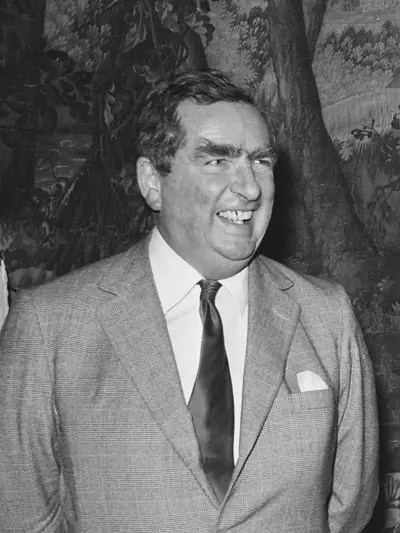
Denis Winston Healey, Baron Healey CH, MBE, PC, FRSL was a British Labour Party politician who served as Chancellor of the Exchequer from 1974 to 1979 and as Secretary of State for Defence from 1964 to 1970; he remains the longest-serving Defence Secretary to date. He was a Member of Parliament from 1952 to 1992, and was Deputy Leader of the Labour Party from 1980 to 1983. To the public at large, Healey became well known for his bushy eyebrows, his avuncular manner and his creative turns of phrase.
