Martin Luther Quotes
Reason is the greatest enemy that faith has: it never comes to the aid of spiritual things, but--more frequently than not --struggles against the divine Word, treating with contempt all that emanates from God.
The anti-intellectualism of many Protestant sects has its roots in this view of Martin Luther’s. The notion of reason as practiced by scientists as a hindrance to religion is not a new notion. Religious leaders have been trying to silence and discredit philosophers and scientists as long as there has been religion. Socrates was killed long before Christianity.
Martin Luther, 1483-1546, German Theologian & Founder of Protestantism, Table Talk, 1569
Sourced by: Eigen's Political and Historical Quotations


He was persecuted by the Roman Catholic Church for figuring out that the earth revolved around the sun which was contrary to church teaching at the time.

In 1877 Wasburn was dropped from the List of Ministers by the Unitarian Church. He had become very critical of organized and orthodox religion of all kinds. He felt that literal interpretations of the Bible harmed religions as it made a mockery of God to claim His truths were the anachronistic and demonstrable falsehoods of the Book of Genesis. Today most Christians and Jews do not take the Old Testament Literally and in this sense Washburn was one of the early religious reformers of America. There is still a significant number of fundamentalist Christians and orthodox Jews who still believe in the literal truth of everything in the Bible.


Judge Moore was trying to justify oaths to God or other state references to a Judeo-Christian God as not violating the 1st Amendment stricture about the government endorsing a particular religion. Note however his {33827} quotation.


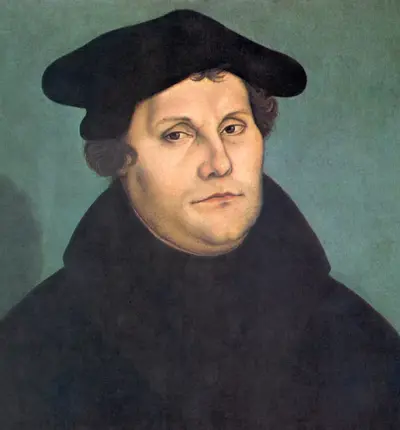
Martin Luther, O.S.A. was a German professor of theology, priest, author, composer, Augustinian monk, and a seminal figure in the Reformation. Luther was ordained to the priesthood in 1507. He came to reject several teachings and practices of the Roman Catholic Church; in particular, he disputed the view on indulgences. Luther proposed an academic discussion of the practice and efficacy of indulgences in his Ninety-five Theses of 1517. His refusal to renounce all of his writings at the demand of Pope Leo X in 1520 and the Holy Roman Emperor Charles V at the Diet of Worms in 1521 resulted in his excommunication by the pope and condemnation as an outlaw by the Holy Roman Emperor.
