Andrew Carnegie Quotes
Private Property, the Law of Accumulation of Wealth, and the Law of Competition... these are the highest results of human experience, the soil in which society so far has produced the best fruit.
Carnegie, Andrew. "Wealth." North American Review, vol. 148, no. 391, 1889, p. 656.


While generally true, Mises here again exaggerates his “proof” by selectively ignoring or being ignorant of counter-examples. The Roman Catholic Church is a classic counter-example where priests, monks, and others owned nothing as individuals, but produced some great science (eg Gregor Mendel), art (the illuminated texts of the middle ages), literature (St Thomas Aquinas, etc). The best counter example that was just evident in the last decade of Misis’ life is Communist Russia. Russian science was better than Fance and Germany and second only to the United States. The Russian ballet and orchestras were second to none. Great literature came out of the Soviet Union and the best of it complained about and attacked the Soviet system of the times. In general, Mises principle tended to be correct throughout history but not always as he dogmatically stated.


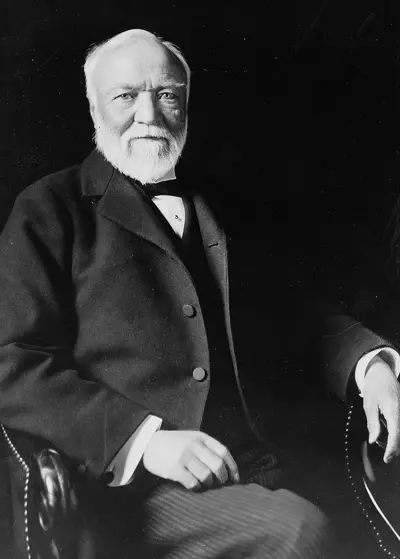
Andrew Carnegie was a Scottish-American industrialist and philanthropist. Carnegie led the expansion of the American steel industry in the late 19th century and became one of the richest Americans in history. He became a leading philanthropist in the United States and in the British Empire. During the last 18 years of his life, he gave away ~$350 million (roughly $5.2 billion in 2019) to many charities, foundations, and universities – almost 90 percent of his fortune. His 1889 article proclaiming "The Gospel of Wealth" called on the rich to use their wealth to improve society and stimulated a wave of philanthropy.
