Robert Kennedy Quotes
President Kennedy's election was such an enlargement. It expanded religious freedom to include the highest office in the land. President Kennedy's administration was such an enlargement. It advanced the day when the bars of intolerance against all minority groups will be lifted, not only for the presidency, but for all aspects of our national life.
Kennedy, Robert F. The Pursuit of Justice. Harper & Row, 1964.


This quotation which appears absurd on the surface given Iran’s terrible record with religious minorities provides insight to Islamic orthodox thought. For the orthodox Muslim, Sharia—Koranic Law—is the basis of the society. God defines the rights of people and their obligations. Whatever rights are provided by Sharia, Khomeini and some others wished to provide them equally to religious minorities also. However, those rights do not include the right to criticize the Islamic law or the leaders who implement it. That would be heresy if done by a Muslim, a Christian, or a Jew. A Christian church may not erect a public cross or ring bells on Sunday. That is prohibited by the Koran and is imposed on all. Bahai religious adherents are tracked down in the Islamic Republic and are often executed. ‘What about their rights?’ they ask. The answer is that the Bahai were Muslims who have become “backsliders” and heretics, and under Sharia, they must be executed for heresy; they are deemed to be heretical Muslims and not members of a minority religion.


This was one of the strongest statements of religious freedom in America prior to the Bill of Rights which came over a decade later.


Pen name: Jack Nipps


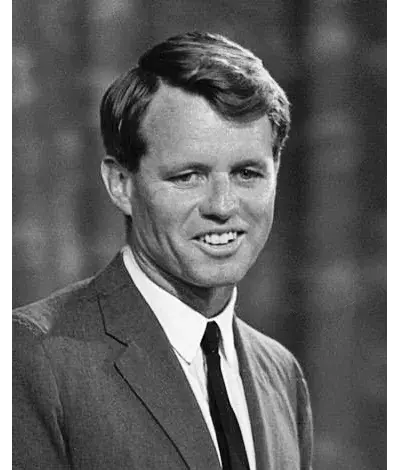
Robert Francis Kennedy, also referred to by his initials RFK or by the nickname Bobby, was an American politician and lawyer who served as the 64th United States Attorney General from January 1961 to September 1964, and as a U.S. Senator from New York from January 1965 until his assassination in June 1968. He was, like his brothers John and Edward, a prominent member of the Democratic Party and has come to be viewed by some historians as an icon of modern American liberalism.
