Heinrich Boll Quotes
Politicians, ideologists, theologians and philosophers try time and again to provide solutions with nothing remaining: prefab solved problems.
Böll, Heinrich. "An Essay on the Reason of Poetry." Nobel Lecture, 2 May 1973. Nobel Lectures, Literature 1968-1980, edited by Tore Frängsmyr and Sture Allén, World Scientific Publishing Co., 1993.


There had just been a terrorist bombing in New York City and a suspect had been arrested. The suspect was a naturalized American citizen who had immigrated from Afghanistan. One of the then presidential candidates, Donald Trump, took to the airways and the internet to use the incident to support his view of prohibiting Muslim Immigrants and visitors entry into the United States. The governor was asked if it was appropriate for a presidential candidate to politicize the event.


From the latter part of the 20th century onward, religious nationalism was no longer a force for most religions and nations except Muslim countries. It was the only religion left where a large proportion of the adherents saw no distinction between the religion and the government. Nations that had separation of church and state were not conducive to the extreme fundamentalist form of Islam where the Secular Leader and the Religious leader was to be embodied as a single person. As a result Islamic religious nationalists argued for a Theocracy and at times fought for it with violent means. The secular government typically, to curtail the violence and prevent a religious takeover, often outlawed the extreme religious Islamic parties. While Aslan cites the Muslim Brotherhood failure in Egypt as a desirable outcome, the only way the other forces of Egyptian society could prevent the Islamists from taking over turning the country into a theocracy was to forcefully repress the extremists. The Turkish outcome was much better, but there was the threat of repression of the Justice and Development Party when it won a majority control of the government. There were explicit threats that if it tried to weaken the secular nature of the government as Ataturk had formulated it, the military would come “out of the barracks” and oust the government as they had done before. There were nations like China which persecuted religions such as certain forms of Christianity, but those religions were not fighting for religious nationalism. They only wished the freedom to practice their religion and had no program or theology that argued for Christianizing the government. The Tamil Hindus of Sri Lanka did not want a Hindu government and were perfectly free to practice their religion. The problem was that they felt that there was systemic social and economic discrimination against the Tamils and they fought for independence—not of a Hindu state, but of a secular, nondiscriminatory state of equal opportunity.

While this was his opinion, it was never issued in a Papal Bull or had the force of Catholic law. Meanwhile, almost all of the socialist movements in the West have had Catholics in their leadership and many democrats of modern times would have been considered socialist. Many countries with high proportions of Catholic voters have elected socialist governments in secluding Spain and Italy.

Of the different kinds of political parties, the one that was formed on principles was at that time a new notion. Hume was particularly skeptical of those as the tended not to be as amenable to compromise as parties unified by simple vested material interests.

This quotation is very critical to people interested in the Libertarian party and libertarian movements. Although she literally “loathed” the libertarians of the day, almost all modern libertarians credit the modern libertarian movement have not only started with her but even into the 21st century she is acknowledged to be the largest intellectual force of libertarianism. Actually, she was a very strong person with very firm ideas, and she was criticized by some people who called themselves libertarian and did not follow her philosophy of individual responsibility and liberty. Her reaction was not only to avoid identifying with them but to differentiate herself whenever she could.


What if you are a conservative in a liberal environment? Then what you are conserving is liberalism.
His reference was to his experience as an undergraduate at Dartmouth, which he and associates views as a liberal organization, while others viewed it as a conservative bastion of the establishment.
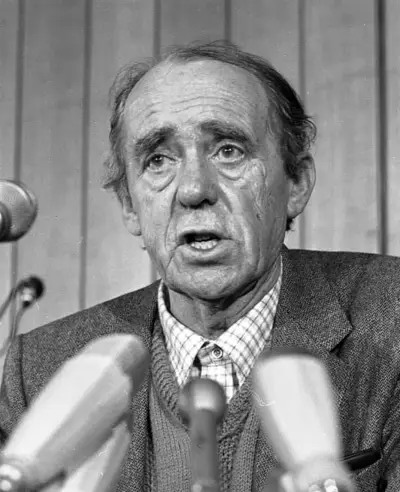
Heinrich Theodor Böll was one of Germany's foremost post-World War II writers. He was awarded the Georg Büchner Prize in 1967 and the Nobel Prize for Literature in 1972.
