Frank Wolf Quotes
Overall, Congress is dysfunctional, partisan, and polarized, and it isn’t getting anything done. We need commissions to break out of divisive partisanship.
Frank R. Wolf, U. S. Congressman Quoted in Jordan Tama, “Three Cheers for Blue-Ribbon Panels”, The Wilson Quarterly, Summer 2011
Sourced by: Eigen's Political and Historical Quotations


This was a very courageous statement by the President because it was his own Republican Party that tended to be the most hostile an partisan. However, where some in Congress listened to his advice, the pressure from the extreme right wing pressured the entire Republican party to new extremes of partisanship and vituperation and under the succeeding President Obama, many Republicans would not support positions that they had formerly voted for and/or advocated because they were favored by the Democratic President or other Democratic leader.


At the time Congress was gridlocked in bitter hyperpartisan conflict. Most people called for more comity and bipartisanship and most politicians wanted more bipartisanship but blamed the other party for the rift. Mourdock, arguing for less bipartisanship and no compromise defeated Richard Lugar in the Republican Senatorial Primary election. Lugar, one of the most respected and effective Senators was a statesman who worked with any and all to find effective compromises to reach national solutions. The nation was so politically polarized that the Republican Indiana voters ousted one of their most senior senators because he was effective at developing national solutions. See {626717} and {302706} for other Mourdock’s outrageous comments. While this rhetoric won in the Primary, it lost him the general election in a state where Republicans had a strong majority and should have had the seat.


The objective of a large proportion of the Congress then was not to improve the nation or even pass legislation, but to preserve their ideology and attack and weaken the other party. Compromise for example is probably the best legislative practice, but that Congress had a substantial number of Tea Party and other ultra conservatives who believed that any compromise at all was an immoral abandonment of principle.


In the beginning of the 21st century political hyper-polarization made Congressional gridlock the norm. Anything that was acceptable to the Democrats would be rejected by the Republicans and vica versa. However, at times, the public would be impassioned by events and demand Congressional action. A movement for gun control after a serious of massacres with assault weapons in 2012 was the example that Thomas was using. If the legislative process could be stretched out until public passions waned, the normal gridlo{78528}k would control and there would be no reform.

2012 and 2013 with the Tea Party driving Republicans more to the right under fear of being attacked in their primary elections caused the handful to shrink to 2 or 3. The change stems from the historical fact that the majority of the Democratic racists (mostly of the South) were furious that their party, had passed the Civil Rights Act of 1964 ending legal segregation and institutional racism of the South. The Republicans implemented a “Southern Strategy” by using code words that endorsed Southern racism and this swung the formerly Democratic “Solid” South to the Republican side changing the balance of power for years. The conservative Democrats became Republicans changing the balance in that party. The conservatives starting purging the liberal Republicans and then drove many of the moderates out. Meanwhile, the Democrats, without their conservative wing from the South became more left wing and made things uncomfortable for the remaining conservatives. Just as Tama predicted there were few moderates left to cross over and vote with the other party. Congress became totally dysfunctional.


With its multiplicity of committees and the polarization of the parties, Congress has been unable to legislate on large, comprehensive problems that involve more than a single issue at a time.

His Republican Party had filibustered more bills in the Senate then had been done previously in all of the Senate History together. Congress passed fewer bills in his first two years than any other Congress in history.
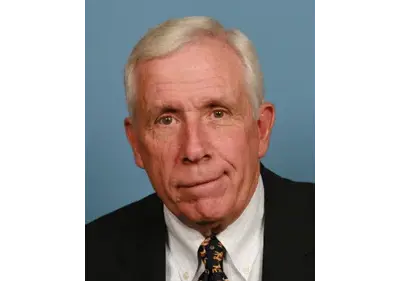
Frank Rudolph Wolf is an American politician who represented Virginia's 10th congressional district in the United States House of Representatives, as a member of the Republican Party, from January 1981 to his retirement in January 2015. He announced in December 2013 that he would not run for re-election in 2014, and retired at the conclusion of his 17th term in office. At the time of his retirement, he was the dean of the state's congressional delegation, having served for 34 consecutive years.
