Marcus Garvey Quotes
Our leader will not be a white man with a Black heart, nor a Black man with a white heart, but a Black man with a Black heart.
Marcus Garvey, 1887-1940, Black Nationalist Leader and Founder, Universal Negro Improvement Association, Statement about the leadership of his new organization
Sourced by: Eigen's Political and Historical Quotations

The Quakers were in the forefront of not only the abolition of slavery but of the integration of the races.


Throughout the Jim Crowe era of the South, the Southern whites were the poorest Americans with the exception of the Blacks, with few economic and cultural opportunities compared with the rest of the nation, the schools were the weakest of any area of the nation, the universities behind, and politically even whites had few choices with single party (Democratic Party) rule. While desegregation was fought tooth and nail by most white Southerners, it had the effect of elevating all phases of Southern life go that the gap between the South and the rest of the country diminished considerably. But the Blacks were also freed from the evil system and that was the “price” to the whites to which Baldwin referred.


Qutb was studying at Greeley College and with some Egyptian friends want to a movie theater. Greeley, even though not in the South, practiced racial discrimination in many of their public accommodations and the Civil Rights Law would not be passed for another 15 years or so. The ticked clerk at first would not sell tickets to the dark skinned Egyptians and when one protested, the owner was called. He ruled that as long as they were not American Blacks, they could enter. But Qutb refused.


In his travels to the Americas Darwin saw some free Blacks but mostly slaves. He thought very highly of Blacks and was an inveterate opponent of slavery.


Of all the defenses is American slavery, this one is probably the most absurd. If it were remotely true, this may have been the only example in human history where people were beaten, debauched, tortured, murdered and degraded by their “friends.”

This view was extremely popular with the White establishment but decried by Du Bois and a few other Black leaders. Unfortunately for African Americans and the rest of the country. Washington in this quotation turned out to be very wrong. Blacks quickly produced all kinds of goods and services that whites wanted, but the Jim Crow culture of the South and much of the North would simply not allow any relations between the races that might diminish the friction. Southerners for over 100 years blamed and resented the Negro for the destruction of the South in the Civil War and trying to act as if he was equal to the whites. And Blacks blamed whites for the century of slavery and then not enforcing the laws and denying them civil rights and equality.


Eight years and a Civil War later, he had changed his mind and was the sponsor of the Civil Rights Act of 1866—the first Federal civil rights law in America. See {587711}.

As enlightened and progressive that his views on Blacks were, he was amazingly racist when it came to Native Americans. See {588991}.
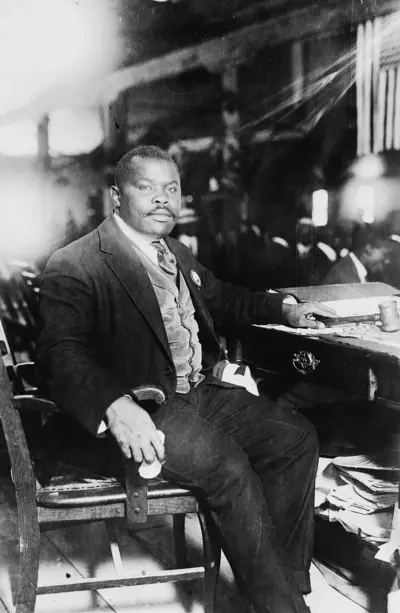
Marcus Mosiah Garvey Sr. ONH was a Jamaican political activist, publisher, journalist, entrepreneur, and orator. He was the founder and first President-General of the Universal Negro Improvement Association and African Communities League (UNIA-ACL, commonly known as UNIA), through which he declared himself Provisional President of Africa. Ideologically a black nationalist and Pan-Africanist, his ideas came to be known as Garveyism.
