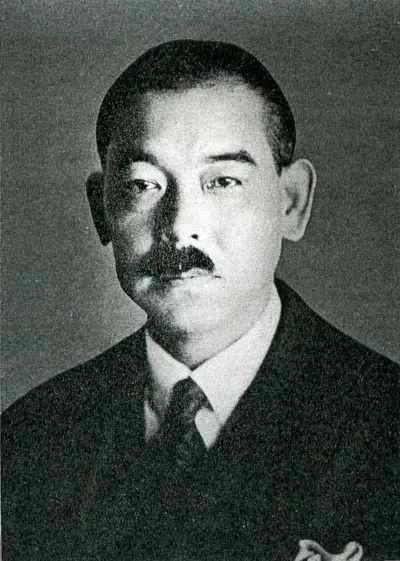
Yosuke Matsuoka Quotes
One Japanese soldier is worth ten Chinese.
Yosuke Matsuoka, *, Japanese Delegate to the League of Nations, Statement, February 25, 1933
Sourced by: Eigen's Political and Historical Quotations


Den was a liberal reformer. There were many liberal politicians in Japan until the right wing militarists took over. Most Japanese were extremely racist and wanted education to be segregated, not unlike the American South at the time. Den’s action described in this quotation was earthshaking to many Japanese. Integration of the schools was to them bad enough, but assimilating Chinese into the Japanese society was much worse.

The Japanese Government was in the control of ardent militarists intent on expanding the Japanese empire. They invaded Manchuria and had designs on China. The League of Nations was very weak, in large part because the United States had not joined when the Senate refused to ratify the treaty. So peace or war In Asia depended on the fascist, military clique that ruled Japan.


Virtually all of the worst dictators were welcomed by many when they first appeared on the scene. Human nature seems to have us all looking for exceptional leaders and statesmen and that is exactly what the dictator relies upon to acquire power, By the time most recognize the truth, the dictator has control of all the levers of compulsion. Many Americans were fooled just as the Europeans were. For others, see {623198}, {623202} and {623201}.

This was an amazing prediction of Germany’s aggression starting two world wars and killing so many millions.


The “Blue Shirts” were so called because of the color of the shirts that the young fascist thugs of the Nationalists wore in China—a color later adopted by the communists for dress. European Fascists tended to have young thug “enforcement” type battalions which were named for the color of their shirts: “Brown Shirts” in Germany, “Black Shirts” of the Fascist movement in England. Ironically, the Red Scare after WWII, convinced American leaders to support Chiang (who called himself and his party the “nationalists”) who was a deep admirer of fascism himself. Chiang’s version of Fascism which combined European type Fascism with traditional Asian warlordism and corruption alienated the majority of the Chinese peasants. America was forced to choose between Chiang led corrupt Nationalist fascists, and Mao led communists. We chose Chiang, but Mau and the Communists won. Chiang’s forces then seized Taiwan and this was the only part of China that did not go communist. After Chiang’s death, the island mini-nation became less fascist and more democratic, and by the 1990’s became a full-fledged democracy.


In World War II, all the Chinese political organizations united to fight the Japanese invaders. The Communists however did most of the fighting and took the heaviest casualties. He proposed turning on their weakened allies and that was accepted by Chiang Kai-shek, the Nationalist leader. They attacked the Communists under Mao and Cho En Lai and forced them to flee across the country in the “Long March”. The Nationalists and their warlords were hated by the majority of the Chinese, especially the peasants who provided help and support to the Communists while they made their escape. They then regrouped and attacked the Nationalists in the Chinese Revolution and this time Chiang Kai-shek, Bai Chongxi and the other Chinese Leaders fled. With few people to help them, they had to flee to Taiwan, and the Communists took over China. Some historians believe that it was Chiang Kai-shek’s strategy all along to hold his soldiers back and let the Communists bear the casualties with the intention of turning on then when the Japanese were expelled. Others claim that Chiang’s relatively unaggressive military action against the Japanese reflected his typical conservatism and avoidance of risk and there was no intention to attack the Communists after the war and the alliance was made in good faith. Note that the leading Muslims in China (where they are a significant minority) were allied with the Chinese Christians against the Communists. Bai Chongxi had a special Muslim newspaper which regularly published religious quoted from the Koran and the Hadith purporting to support and justify Chiang Kai-shek, a Christian, as the rightful leader of China. This was another example of Islam being hijacked for a narrow political purpose. Also, note his use of the word “bandits”. This is a huge insult in the Chinese language culture. So of course the Nationalists used it to refer to the Communists—See {613286} .

In 1918 the Treaty of Versailles—peace treaty ending WWI—was signed. Many Germans felt that their defeat in WWI forced them to sign the treaty which weakened Germany and assured that they would be a 2nd rate power thereafter. After that Germans blamed every negative aspect of their government, economy and society on the treaty that was “forced” on them. Nazism was a consequence of these feelings, and the Nazis adopted policies and practices to get around their anti-military obligations and have a strong government so that the allies could not enforce the treaty obligations on Germany.


This quotation shows that the racism and master race of Nazi Germany was a norm in Germany well before Adolf Hitler and the Nazis. It was an endemic part of the culture. This makes the German post WWII reforms all the more remarkable as the vast majority of an entire nation had to radically change its world and personal views and perceptions.

Before American entry into the War with Japan, Chiang Kai-shek and the Soongs maintained that they were fighting the Japanese but it was not generally true. They were fighting Mao and his Communists while Mao was fighting the Japanese. By 1942, under pressure from the United States and Russia, the Nationalists and Communists agreed to a truce so that they could both fight against Japan. Based on the promises made to President Roosevelt by Madam Chiang, the Soongs, and Chiang himself, there was an expectation of extensive military attacks against the Japanese. The U. S. then sent a large amount of military aid to Chiang Kai-shek, but there did not appear to be any significant attacks against the Japanese other than those mounted by the Communists. Magruder, General Marshall’s emissary to Chiang Kai-shek was instructed to investigate. When the war ended, Chiang Kai-shek used the assets he was saving in to attack Mao and his communists just as he had done before the truce. Magruder had been right. However, just as Chiang could not defeat the militarily inferior Communists before the truce, he could not do so after. Soon Mao turned the tables and drove Chiang Kai-shek and his Nationalists out of Mainland China. President Roosevelt had brilliantly judged the ability of England, Russia, and Yugoslavia to fight the Germans, but as this quotation and {641677} shows, he listened to the wrong people. He had been sold a “bill of goods” by the China Lobby, the Soongs and Chiang Kai-shek.

Germany before Hitler was a very narrow, formal, rigid, militaristic, class conscious, authoritarian, society.