Albert Einstein Quotes
One cannot abolish only a single weapon, but only war as a whole.
Albert Einstein, 1879-1955, Nobel laureate in Physics, Interview with Milton James, October 7, 1948
Sourced by: Eigen's Political and Historical Quotations


After the First World War, the United States and other countries were very conscious of the possibility of foreign arms sales encouraging and facilitating war and aggression. Therefore, arms shipments were very limited. The exception allowed tyrannical governments often to suppress, and often kill, their own citizens. By the end of the 20th century, the United States would sell arms to almost anyone and was the largest arms supplier in the world. Much of the flip flop of position on arms exports was caused by the fact that other nations were shipping arms and getting the jobs and profits associated with those exports and almost anyone in the world with money could buy arms. So the United States allowed its arms manufacturers to compete in this lucrative business to all but a few arms embargoed nations with whom we were having international difficulty.


The Palestinians in Gaza, led by the Terrorist Group Hamas, fired over 1000 rockets into Israel killing 5 people. The Israeli Defense forces finally retaliated and destroyed much of the Hamas infrastructure and killing the Hamas military leader. A number of other countries were trying to broker a cease fire and Blitzer was trying to determine what each side wanted.


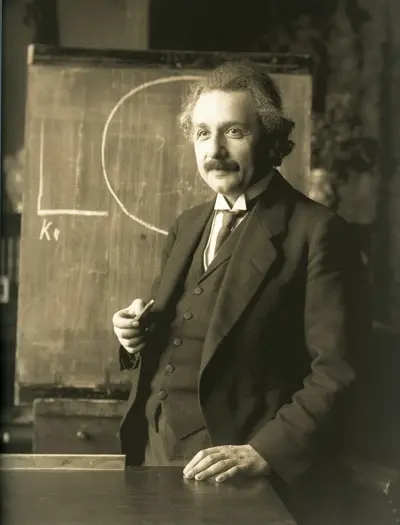
Albert Einstein was a German-born theoretical physicist, widely acknowledged to be one of the greatest physicists of all time. Einstein is known for developing the theory of relativity, but he also made important contributions to the development of the theory of quantum mechanics. Relativity and quantum mechanics are together the two pillars of modern physics. His mass–energy equivalence formula E = mc2, which arises from relativity theory, has been dubbed "the world's most famous equation". His work is also known for its influence on the philosophy of science. He received the 1921 Nobel Prize in Physics "for his services to theoretical physics, and especially for his discovery of the law of the photoelectric effect", a pivotal step in the development of quantum theory. His intellectual achievements and originality resulted in "Einstein" becoming synonymous with "genius".
