Thomas P.M. Barnett Quotes
Once Europe's colonial empires were sent into deep decline, thanks to World War II, America became globalization's primary replicating force, integrating Asia into its low-end production networks across the second half of the twentieth century - just like Europe had integrated the U.S. before.
Barnett, Thomas P.M. Great Powers: America and the World After Bush. G.P. Putnam's Sons, 2009.


He was thrown out of the Labour Party for his pro Cold War and Soviet statements.


He was referring to the Franklin Delano Roosevelt negotiations with Churchill and Stalin at the Teheran Conference of 1943. Roosevelt insisted upon, and got his way of including China as one of the major allied powers to be among the main “Allies”. of WWII. Another factor that motivated FDR to push for China’s inclusion was that there was a very strong “China Lobby” led by Time/Life publisher Henry Luce in America that were urging such a policy.


In both the First and Second World Wars the Western nations had a multilateral defense pact which did little good in the face of German aggression.
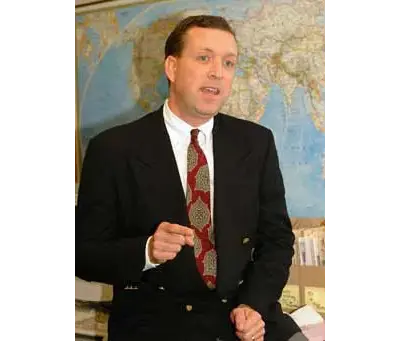
Thomas P.M. Barnett (born 1962) is an American military geostrategist and former chief analyst at Wikistrat. He developed a geopolitical theory that divided the world into "the Functioning Core" and the "Non-Integrating Gap" that made him particularly notable prior to the 2003 U.S. Invasion of Iraq when he wrote an article for Esquire in support of the military action entitled "The Pentagon's New Map" (which would later become the title of a book that would elaborate on his geopolitical theories). The central thesis of his geopolitical theory is that the connections the globalization brings between countries (including network connectivity, financial transactions, and media flows) are synonymous with those countries with stable governments, rising standards of living, and "more deaths by suicide than by murder". These countries form the Functioning Core. These regions contrast with those where globalization has not yet penetrated, which is synonymous with political repression, poverty, disease, and mass-murder, and conflict. These areas make up the Non-Integrating Gap.
