Mikhail Gorbachev Quotes
On the day I became Soviet leader, in March 1985, I had a special meeting with the leaders of the Warsaw Pact countries and told them: 'You are independent, and we are independent. You are responsible for your policies, we are responsible for ours. We will not intervene in your affairs, I promise you.'
Gorbachev, Mikhail. On My Country and the World. Translated by George Shriver, Columbia University Press, 2000, p. 191.


Inscribed in the John Adams Building of the Library of Congress. On this subject Jefferson was in agreement with George Washington {37176} and his political opponent, John Adams {592705}.


Under the Kissinger Foreign Policy this was his oft stated policy. The United States however gave a great deal of advice about their internal affairs to foreign leaders. Those that did not take it, did not get as much foreign or military aid, and sometimes found themselves ousted in a coup which resulted in a regime change or with their country being boycotted.


Shahin’s empire which he conquered for Khosrow II comprised all of the Middle East into parts of India. The Byzantine Roman Empire controlled everything from Constantinople to the West. They were the two “superpowers” of the day. It seemed to Shahin that no empire could ever be greater, but that is the common hubris of siperpowers.


American Presidents after Wilson have not, in general, shared this view. By the latter part of the 20th century judgmentalism was a major component of American foreign policy and reached its zenith with the administration of George W. Bush.


In 1983 in the wake of the Korean airliner shootdown, there were diplomatic arguments of landing rights in New York for Russian U. N. diplomats. This prompted some U. N. member nations to call for the removal of the U. N. from New York:


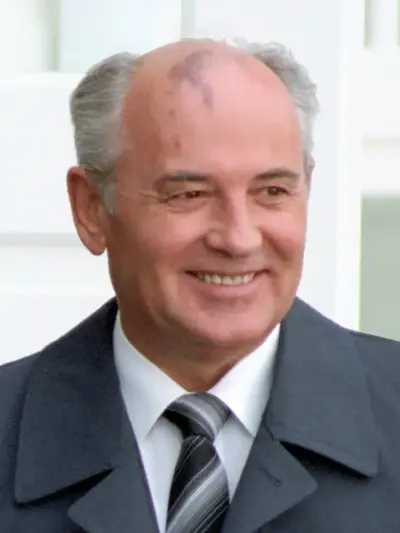
Mikhail Sergeyevich Gorbachev is a Russian and former Soviet politician. The eighth and last leader of the Soviet Union, he was the General Secretary of the Communist Party of the Soviet Union from 1985 until 1991. He was also the country's head of state from 1988 until 1991, serving as the chairman of the Presidium of the Supreme Soviet from 1988 to 1989, chairman of the Supreme Soviet from 1989 to 1990, and president of the Soviet Union from 1990 to 1991. Ideologically, Gorbachev initially adhered to Marxism–Leninism, although he had moved towards social democracy by the early 1990s.
