William Hull Quotes
No white man found fighting by the side of an Indian will be taken prisoner; instant death will be his lot.
The invasion failed, Hull lost even Detroit and the Michigan territory and was later court-marshaled.
William Hull, 1753-1825, General, Governor of the Michigan Territory, Proclamation to the Canadians upon his attempted invasion of Canada where some Indians were fighting with the British, July 12, 1812
Sourced by: Eigen's Political and Historical Quotations

Enemy captives were sometimes adopted by Indian families to replace a lost loved one.

In April 1832, Black Hawk led his warriors into Illinois to recapture their ancestral lands. The attempt was thwarted by American Army and Navy forces, and Black Hawk surrendered. Several months later he was sent East to meet with President Andrew Jackson. At that meeting, Black Hawk told the President:


Clark’s men had English Colonel Hamilton under siege by making him think there were many more Americans in Clarks army than the real 180 or so. He tried to get Hamilton to surrender by threatening if they had to take the fort they would treat Hamilton and the British as murderers—Hamilton had paid hostile Indians for American scalps. At that point a party of Clark’s men arrived with 4 or 5 Indian prisoners who had been captured raiding
civilian farms. After the Indians were executed, Hamilton agreed to surrender.


Doty acquitted Chief Oshkosh who had murdered another Indian in retaliation of the murder of one of his tribe. Under the Indian customs of the time, revenge killings were normal and expected. The white citizens were outraged and voted Wisconsin’s first judge out of office. He later became Governor of the territory and when Wisconsin became a state, Doty became its Congressman.

This is the Admiral who commanded that invasion of Washington DC and the burning of the White House. It was in retaliation for the destruction of buildings in the American invasion of Canada that began the War of 1812.

Americans General William Hull had crossed the Canadian border with 2500 men announcing his intention to invade. Fearing the military tactics of the Indians, he issued an edict stating that Indians (and whites fighting alongside Indians) would be shot rather than taken prisoner.
The FLQ was a Quebec revolutionary group seeking Quebec independence from Canada.


Mather was urging the community to protect their children against the Devil and his band. To exemplify just how terrible Devils were to his audience, he used a comparison to the worst thing the audience was familiar with—Indians. Although there were a few examples in Colonial America of Indians being perceived as benign or even people, they were few and far between, and tended to be in New York and Pennsylvania.

The rationale for paying these Indians was given in the beginning of the treaty. See {612283}. In addition the treaty provided for the Federal government to build a flour mill and a saw mill and provide technical staff to operate and maintain them. In an interesting gesture the Federal government rebuilt a church that had been the house of worship for some Oneida Presbyterians. The English and the other Iroquois had burned the church to the ground. See {621968}. This is one of the few times in history, and certainly the first time, that the Federal government constructed a church for a particular sect. The other tribes of the Iroquois nation had allied themselves with the English. See {583726}. Only the Oneida joined the colonist cause. At the end of the war, the other Iroquois tribes were run out of the country and they escaped to Canada. The Oneida, in contrast, were rewarded by the Federal government and integrated into New York State society.
The quotation is actually combined from two different speeches, July 28 and August 21, 1725. The dependency on guns and gunpowder was one of the key elements that was creating the dependency. See {613048}.


At the time there were relatively few natives left. The remainder were hunted and exterminated. Only 75 were left at the end of the “Black War” where there had been about 5,000 at the beginning. See {618042}.


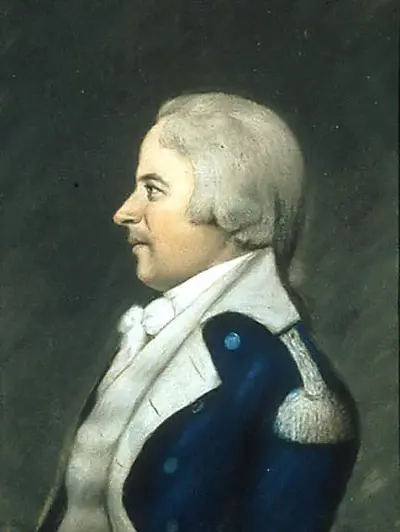
William Hull was an American soldier and politician. He fought in the American Revolutionary War and was appointed as Governor of Michigan Territory (1805–13), gaining large land cessions from several American Indian tribes under the Treaty of Detroit (1807). He is most widely remembered, however, as the general in the War of 1812 who surrendered Fort Detroit to the British on August 16, 1812 following the Siege of Detroit. After the battle, he was court-martialed, convicted, and sentenced to death, but he received a pardon from President James Madison and his reputation somewhat recovered.
