Xenophanes Quotes
No human being will ever know the Truth, for even if they happen to say it by chance, they would not even known they had done so.

Proof in a scientific and mathematical context is very different from the legal concept of proof. For Feynman, proof consisted of both being able to deduce a statement in much the same way as a proof is offered in plane geometry and being able to construct an experiment which will demonstrate the validity (confirm the prediction of what will happen all cases. As a theoretical physicist, most of his proofs were of the mathematical, deductive kind. There are many phenomena in mathematics and science that were, and are, known long before someone was able to offer a proof.


This seemingly abstruse philosophical statement actually found its way into one of the major political debates of the 21st Century when the Secretary of Defense was defending the management of the Iraq War and the interpretation of intelligence. See {586062}.


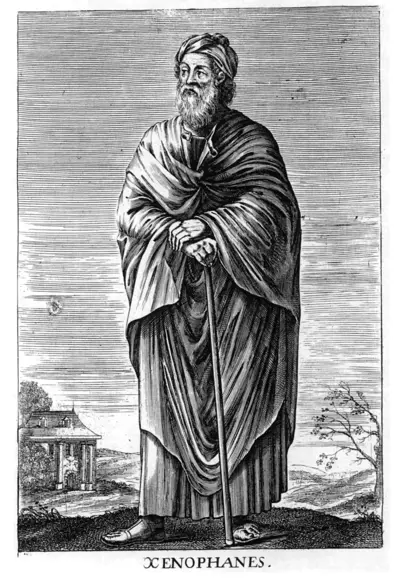
Xenophanes of Colophon (/zəˈnɒfəniːz/; Ancient Greek: Ξενοφάνης ὁ Κολοφώνιος [ksenopʰánɛːs ho kolopʰɔ̌ːnios]; c. 570 – c. 478 BC) was a Greek philosopher, theologian, poet, and critic of religious polytheism. Xenophanes is seen as one of the most important Pre-Socratic philosophers. Eusebius quoting Aristocles of Messene says that Xenophanes was the founder of a line of philosophy that culminated in Pyrrhonism. This line begins with Xenophanes and goes through Parmenides, Melissus of Samos, Zeno of Elea, Leucippus, Democritus, Protagoras, Nessas of Chios, Metrodorus of Chios, Diogenes of Smyrna, Anaxarchus, and finally Pyrrho. It had also been common since antiquity to see Xenophanes as the teacher of Zeno of Elea, the colleague of Parmenides, and generally associated with the Eleatic school, but common opinion today is likewise that this is false.
