Louis D. Brandeis Quotes
Neutrality is at times a graver sin than belligerence.
Louis D. Brandeis, 1856-1941, U. S. Supreme Court Justice, Quoted in S. Goldman, The Words of Justice Brandeis, 1954
Sourced by: Eigen's Political and Historical Quotations


The English were at War with Napoleon and Denmark was neutral. British leaders feared that Denmark might either ally themselves with Napoleon or provide him with ships from their well equipped fleet. The English decided on a preemptive attack on Denmark and Paget and other Captains were ordered to Denmark. When they arrived they were ordered to bombard Copenhagen and force the Danes to surrender. When this happened, the British seized the Danish ships and simply took them as war prizes. The issues of the morality and wisdom of preemptive attacks, as with the Americans in the Iraq war, was thoroughly debated but the government view prevailed to the shame of most Englishmen.


Theodore Roosevelt was the Presidential nominee. Johnson was a leader of some members of Congress some of whom were extreme isolationists and some of whom were Nazi sympathizers and Hitler admirers. When the Japanese attacked Pearl Harbor later that year, Germany, fulfilling its treaty with Japan, declared war on America, Johnson’s group no longer mattered. Before WWII most Republicans were opposed to Defense Spending and accused the Democrats of being war hawks. After WWII, they flip flopped and became more hawkish than the Democrats who they accused of being soft on defense for years thereafter. See {631380} for President Roosevelt’s different view.

This was a precursor of the total war views of William Tecumseh Sherman and Ulysses S. Grant during the American Civil War half a century later.

Kennedy said that he was quoting Dante. However, he or his speechwriter, got the quote wrong. In the Devine Comedy, Dante had a hot place in hell for the neutral, but the hottest place was reserved for traitors. Many people since then use this quote and attribute incorrectly to Dante because Kennedy’s version is the only one with which they have come in contact.


In the 18th Century, the Islamic Barbary States combined their religious beliefs for Jihad against non-believers with a classic criminal enterprise--piracy. They would authorize corsairs to outfit ships and attack Christian merchant ships on the high seas. They would capture the ship and the cargo, which would be split with the ruler of the country. The crew and passengers would by “rented out” as slaves until they would be ransomed, the proceeds of which would also be shared. To motivate a larger ransom, the captives were regularly tortured as well as worked almost to death. The Barbary Pirates encouraged the “slaves” to write to their relatives, friends and governments to try and raise the ransom. Individual Christian countries were offered a “treaty” whereby for an annual payment of tribute to the Barbary country, the corsairs of that country would not attack ships flying the flag of the country that paid the tribute. The Christian country had to make 4 different tribute payments to each of the 4 Barbary nations. Most of the European powers were paying the tribute even though some could easily defeat the Corsair navies in a war. The cost of outfitting a fleet for war was much more greater than paying the tribute. The new nation of the United States was good pickings for the Barbary pirates and there was a period of several decades where the Americans had to create a policy to pay tribute or go to war. At different times America did both. Jefferson argued for War rather than pay the blackmail tribute.

This appears to be the first use of the phrase used subsequently by leaders throughout the world.


She and most other German scientist fled from the Nazis—she to Sweden. Hahn, her former collaborator, remained in Germany and worked for the Nazis. The letter was written in the expectation that Moe Berg, an American OSS agent would have it delivered to Hahn in Germany. So far as anyone can tell, it was never delivered but was used by the OSS for analysis of German physics prowess.

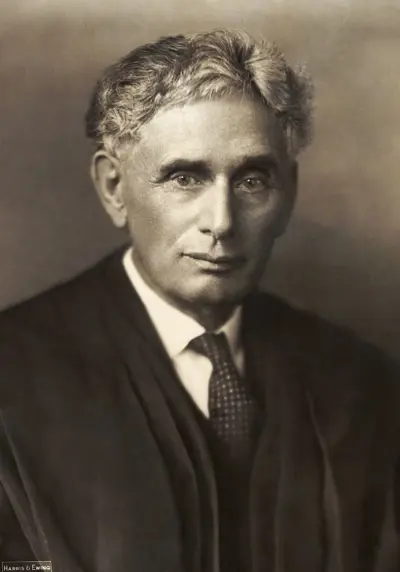
Louis Dembitz Brandeis was an American lawyer and associate justice on the Supreme Court of the United States from 1916 to 1939. He was born in Louisville, Kentucky, to Jewish immigrant parents from Bohemia (now in the Czech Republic), who raised him in a secular home. He attended Harvard Law School, graduating at the age of 20 with the highest grade point average in the law school's history. Brandeis settled in Boston, where he founded a law firm (that is still in practice today as Nutter McClennen & Fish) and became a recognized lawyer through his work on progressive social causes.
