Ferenc David Quotes
Neither the sword of popes, nor the cross, nor the image of death — nothing will halt the march of truth.
Ferenc David, 1510–1579, Founder of the Unitarian Church in Transylvania, His last words, carved onto the walls of his dungeon cell, 1579
Sourced by: Eigen's Political and Historical Quotations


Jews were forced to convert to Catholicism under penalty of death. While the archbishop did not approve, he did not describe the murders in moral terms or used his great religious power to stop the practice.

While this is very true in the long term, the Church in the short term has almost always supported actively or by its neutrality, the ruling class as opposed to those who would make revolutionary change even to the extent of participating in the torture, murder, and intimidation of most of the Catholics in the society. The ruling class, in turn, supported the Church and used the power of the state to enforce religious doctrine and prevent alternative religious views and practices to prevail even if only with small minorities. See {632407} for another Mises quotation articulating examples of this.

Politicians and rulers have always used necessity to justify what they wanted to do in crises.


This quote is significant for several reasons. First, it illustrates the theological dimension of the Saudi Arabian kingdom where the Royal Family maintains its position by always accommodating and financing the Wahabi fundamentalist version of Islam. Second, it shows how difficult it is for modern science to be taught and understood in fundamentalist Islamic societies. Third, it illustrates a historically classic repressive logic: He who disagrees with the current religious orthodoxy is disagreeing with the espousers of that religion. And if the espousers are wrong, they are lying. Therefore the dissenter is accusing God and his prophets of being liars. That is blasphemy and an insult to all believers. Last, it illustrates the parallel between Islam and Christianity in development. The latter is 700 years older than Islam, and about that long ago, the Roman Catholic Church repressed Galileo for claiming that the Earth was not the center of the universe.

The Vatican & the Chinese Communist Government had been at odds for years with much of the Chinese church going underground. Fr. Jin had been jailed for a decade. Then the government allowed him and the Catholic Church and operate openly, but there were still Vatican conflicts over numerous issues including the right of the Government to approve senior appointments of church officials—a privilege the church claimed exclusively. The Vatican ordered Jin not to cooperate and especially not to reopen the national theological seminary which the government had ordered closed. There had been no training for Chinese priests and Jin wanted to reopen the national theological seminary but the Vatican refused cooperation waiting for the government to capitulate to the Vatican’s various demands. Fr. Jin defied the Vatican & reopened the seminary. Without officially admitting their failed tactics, the Vatican let the discipline issue against Jin drop & the national theological seminary thrived.

Executed by the English for his part in the Easter Uprising. His observations seem even more prescient as later theocracies like Iran ruined their societies and progress and twisted the Islamic religion. Ireland’s independence did not separate the state from the control and influence of the Roman Catholic Church despite the warnings of Connolly and others. However, conflict with the Church in 2010 over the church sexually assaulting children and impeding the civil authorities from investigating and protecting the criminals led to a reexamination and a diminution of the role of the church in Ireland.


Ingersoll was considered to be the greatest orator and political thinker of his day, but his overt atheistic views curtailed his elected political career.

Islam had been the center of intellectual thought in the world, until the clerics had decided that innovation itself was a sin and one that called for the death penalty. Although most non-Muslim religions went through stages of death for religious dissent. However, the Koran deals with every part of society. There is no separation of church and state. All knowledge is in the Koran the fundamentalist believes and anyone who expresses a new idea is not only wrong and a heretic, but is dangerous and must be executed. It is therefore not very surprising that the Islamic contributions to science, medicine, and the arts has been so small. The Islamic fundamentalists are opposed by Muslim modernists who try to change the Islamic culture but they are on the minority. Most religions have gone through bad earlier periods where dissent was heresy and warranted death. Fundamentalist Islam is the only one which bans original thought of any kinds even it does not contradict established doctrine.

The Christian Roman Empire was split in two—a Western (Latin) Empire led by the Roman Catholic Church in Rome, and the Eastern (Greek) Roman Empire led by the Orthodox Church headquartered in Constantinople (Byzantium). The two churches were not only in a theological conflict but violence broke out and the armies of the two religious empires attacked each other now and then. In 1439, leaders of the two versions of Christianity met in Florence, and they agreed to reunuion in which the Eastern Orthodox would again acknowledge the authority of the Pope. This was not a popular agreement with the majority of the Eastern Orthodox people and some of the clerical leadership. Constantine, realizing that he did not have pubic support at home for the end to the schism and the acceptance of the authority of the Pope, kept stalling on officially announcing and implementing the unity treaty. The Pope’s patience was wearing thin. Constantine did not adhere to ther treaty and the two churches have been apart ever since.


Spinoza’s ideas were considered so radical and dangerous that he was the only man in history who was excommunicated by the Catholics, the Jews and the Muslims. This was his observation after his first excommunications -- by his Jewish Congregation in Amsterdam.

Since Pope Francis was so modern in so many areas there were hopes among some Roman Catholic reformers that the Pope would change the age old, discriminatry prohibition against women being priests.

The King had earlier replaced the Pope as the head of the English church. The references to money referred to a then common corruption of the Church whereby people could buy indulgences—religious papal pardons of past or future sins. This was a major revenue source for the Vatican and a major issue for Martin Luther and the Protestant Reformers some of who saw the pope as the Devil incarnate See {623153}. For Martin Luther’s view pf the practice and {626720}, {595195}, and {639436} for other contemporary views.
The Christian world was in a great struggle with Islam. The Sultans were trying to take over Constantinople—the seat of the Eastern Orthodox Church. The Western Catholic Church in Rome also yearned for unification but under the Pope and his Cardinals. Notaraus feared them more than the Ottomans. Howeer, it was the latter who conquered Constantinople (Byzantium) in 1453 and executed the “first family” when Notaras would not deliver his children to Sultan Mehmet as hostages for assuring “good behavior” by the Greek community.
The colonial American were quite knowledgeable about trials like this one which were occuring all over Europe. The result was the demand for the First Amendment in order to ratify the original Constitution. In this particular case, the major crime that triggered the investigation and trial was the fact that La Barre did not remove his hat in respect as a religiohs procession of Corpus Christi went by. During the investigation, the mayor searched La Barre’s residence and found blasphemous literature the worst of which appeared to be Voltaire’s Philosophical Dictionary which the Mayor ordered to be burned along with the head and body. The photo is a plaque in Abbeville to the victim reminding all of the danger of mixing religion in civil law.
He was officially hanged for his offence of blasphemy. See {619712}. His execution, which raised considerable concern, was the last execution for blasphemy in Britain.

The Papacy was at one of it’s lowest points. Two men, Clement and Urban, both claimed the Papacy and each had raised an army to fight the other. Each was promising indulgences to those who would fight, and in a modality similar to the Muslim terrorists of the 21st century, the soldiers were promised ascendancy to Heaven if they fell in battle for such a holy cause. The armies of the popes marched under the cross as their banner, and Wycliffe found that obscene and actually wrote a treatise saying so. See {618087}.
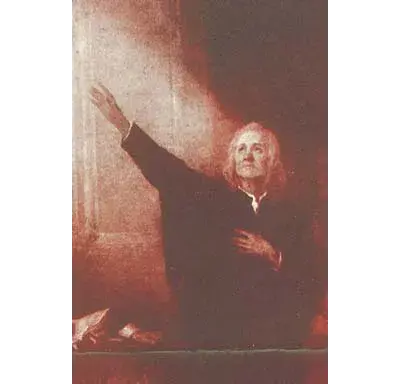
Ferenc Dávid was a Unitarian preacher from Transylvania, the founder of the Unitarian Church of Transylvania, and the leading figure of the Nontrinitarian movements during the Protestant Reformation.
