Gary Johnson Quotes
My supporters are people who believe in being fiscally responsible and socially accepting. I think most people are in that category. Speaking with a broad brushstroke, those are my supporters.
Johnson, Gary. Interview by Judy Woodruff. PBS NewsHour, PBS, 13 July 2012.


Perry was one of a number of politicians who became opposed to deficit spending, and claimed that the public was not interested in the various projects. However, whenever any of these politicians proposed projects or programs to cut, there would be many citizens who would object vehemently. It was precicely because there was a constituency supporting all the government programs that politicians found it so hard to keep spending under control. Indeed, when others suggested terminating spending on programs and projects Perry liked, he objected as strenuously as most others.

Bloomberg was one of the few people who say the meltdown of 2008 coming. His principle of saving a surplus for spending in the downturns, which served New York so well goes against most Democrat and Republican politicians. If there is a surplus, the Democrats want to spend it. The Republicans want to cut taxes and return the surplus. Neither is prepared for an economic slowdown.

1st Viscount Snowden


Roosevelt understood the value of symbols in forming public perception, and vetoes are often used by presidents to create a symbolic message.


This quotation pithily summarizes a common problem in politics of describing budgets. In most years there has been a national inflation. If a new budget is, in actual dollars, the same as the previous years or a little more, but the increase is less than the inflation level, the agency will not be able to provide the same level of services as the previous year. Therefore services will be cut and those who are politically in favor of more money for the program legitimately describe this as a “budget cut”. Opponents of larger funding increases, also legitimately describe the funding as a “budget increase”. One side refers to what the money can buy and the other, to the absolute dollars spent. This is an example of the classical ambiguity of political oratory.


Referring to Arizona Governor Fife Symington III (Republican) who, after winning the governership, declared personal bankruptcy, had his businesses collapse and was indicted for fraud:

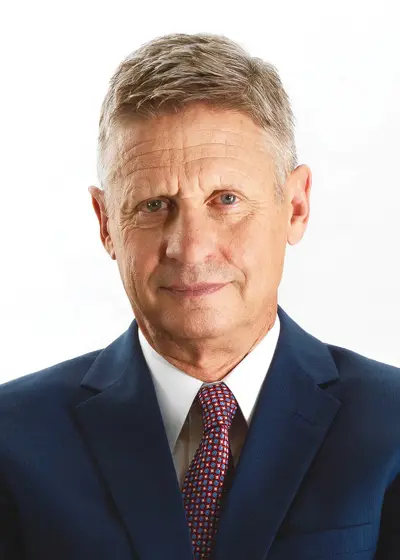
Gary Earl Johnson is an American businessman, author, politician, and former presidential candidate who served as the 29th governor of New Mexico from 1995 to 2003 as a member of the Republican Party. He was the Libertarian Party nominee for President of the United States in the 2012 and 2016 elections. He was also the Libertarian nominee in the 2018 U.S. Senate election in New Mexico.
