Wilhelm II, German Emperor Quotes
My Reichstag behaves as badly as it can, swinging backwards and forwards between the socialists egged on by the Jews, and the ultramontane Catholics; both parties being soon fit to be hung all of them, as far as I can see.
The two were cousins. Wilhelm was a very dominant personality and his cousin quite weak. This quotation shows the tyrannical view of the German Kaiser. The letters were secret but after the execution of the Czar, the Russians released the letters to show the dominant and warlike history of Germany under the Kaiser who was furious that the Russians had made such personal and secret letters public.
Wilhelm II, 1859-1941, Emperor of Germany & King of Prussia, Letter to Czar Nicholas of Russia, January 5, 1895
Sourced by: Eigen's Political and Historical Quotations

Vladimir Lenin. Despite Lenin’s abhorrence of anti-Semitism, there were any other Russians for whom it was normal. After Lenin’s death, Stalin and his henchmen used anti-Semitism to divert attention from the Communist Party’s failure to meet its economic and other goals.

This classic quote illustrates how rapidly things can change. A decade later most German Jews either emigrated or were murdered.


This quotation provides an insight into Stalin’s bizarre and ruthless character.

He was one of the early predictors of the fall of the Soviet Union. See {586209} for part of his reasoning.

The basis of his complaint essentially was that he and his military and supports were no worse than the guys why they were killing and if they did not continue fighting and kikking, they themselves would be killed. While there was some truth to that, Assad was one of the worst dictators of the post WWII era. His indiscriminate shooting, shelling and air strikes on women & children, hospitls and schools, and the use of poison gas was enough to justify the image of him as a "bad guy".


There was a German anti-Semitic movement then to expel the Old Testament and everything that related to the Jewish People out of Christianity. In the early days of irrational anti-Semitism and Nazism he was one of the few who preached against the hateful Nazi propaganda. – See {638919}. However, when it became clear that the Nazis had the upper hand, he publicly recognized the Nazi government as legitimate, required Catholic clergy to remain loyal to the Nazi government, and maintained bridges between fascism and the Church He then became intimidated and became silent on the terrible inhuman, un-Christian treatment of the Jews concentrating his efforts on negotiating the best for the Catholics that he could get. See {639129}.

From the latter part of the 20th century onward, religious nationalism was no longer a force for most religions and nations except Muslim countries. It was the only religion left where a large proportion of the adherents saw no distinction between the religion and the government. Nations that had separation of church and state were not conducive to the extreme fundamentalist form of Islam where the Secular Leader and the Religious leader was to be embodied as a single person. As a result Islamic religious nationalists argued for a Theocracy and at times fought for it with violent means. The secular government typically, to curtail the violence and prevent a religious takeover, often outlawed the extreme religious Islamic parties. While Aslan cites the Muslim Brotherhood failure in Egypt as a desirable outcome, the only way the other forces of Egyptian society could prevent the Islamists from taking over turning the country into a theocracy was to forcefully repress the extremists. The Turkish outcome was much better, but there was the threat of repression of the Justice and Development Party when it won a majority control of the government. There were explicit threats that if it tried to weaken the secular nature of the government as Ataturk had formulated it, the military would come “out of the barracks” and oust the government as they had done before. There were nations like China which persecuted religions such as certain forms of Christianity, but those religions were not fighting for religious nationalism. They only wished the freedom to practice their religion and had no program or theology that argued for Christianizing the government. The Tamil Hindus of Sri Lanka did not want a Hindu government and were perfectly free to practice their religion. The problem was that they felt that there was systemic social and economic discrimination against the Tamils and they fought for independence—not of a Hindu state, but of a secular, nondiscriminatory state of equal opportunity.

The Alawites, always a Muslim minority in Syria, have been hated, distrusted, discriminated against, and physically persecuted by the majority Sunni Muslims as long as they have existed. When in Syria, the Alawites, although a minority, gained political control of the country and for the first time were secure in their own country. In the early 2000s, the Sunni majority tried to oust the Alawite leadership, but the Assad government put down the protests brutally. Most Western observers did not know of the anti-Alawite history of persecution in Syria. Returning to that position of victimization was so feared by the Alawites that they fought tooth and nail, murdering many civilians, to be sure that the historical position of the Alawites would not occur again. This makes talks and negotiations over the Syrian Civil War so difficult. The Alawites believe that if they do not control the nation, they will be massacred by the majority. The Christians and the Jews also believe that if the Sunni’s get control, their communities will be in great danger. Complicating the situation even further, is that fact that of the insurgent Sunni groups, the tolerant secular ones who started the revolution are no longer in control of the insurgents. De facto dominance has passed to the Jihadist, Islamic extremists who hold the view expressed by this quotation.


It is amazing what explanations religious and biased fanatics can come up with to explain history.
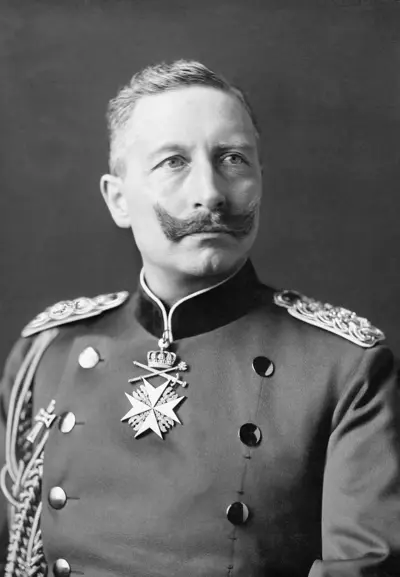
Wilhelm II, anglicised as William II, was the last German Emperor (Kaiser) and King of Prussia, reigning from 15 June 1888 until his abdication on 9 November 1918. Despite strengthening Germany's position as a great power by building a blue-water navy and promoting scientific innovation, his tactless public statements greatly antagonized the international community and his foreign policy was seen by many as one of the causes for the outbreak of World War I. When the German war effort collapsed after a series of crushing defeats on the Western Front in 1918, he was forced to abdicate, thereby bringing an end to the three-hundred-year rule of the House of Hohenzollern.
