Moncef Marzouki Quotes
My country proposes that we consider that dictatorship is a disease, a disease that is threatening peace and security as well as the prosperity of people … a social and political scourge which needs to be eliminated.
Moncef Marzouki, President of Tunisia, “100 Top Global Thinkers”, Foreign Policy, December 2012
Sourced by: Eigen's Political and Historical Quotations


The President was reacting to a chain of vents whereby Sony Entertainment produced a satiric movie which offended the leadership of North Korea who condemned, threatened and may have launched a cyberattack on Sony. That company reacted by withdrawing the movie and the President thought that was a mistake despite the fact that there were threats against theaters showing the movie and people attending the showings.


Although nether he or the Sultan had made vigorous efforts to stop the massacres, he had promised the world community that Turkey would see that justice was done (See {620596} ). However, there were a few tried and one governor of a province was hanged and a few others received short jail sentences. Talaat, the worst of The Young Turks regarding the genocide, escaped to Germany. But he was tracked by a surviving Armenian who assassinated Talaat. The assassin was acquitted by a sympathetic German court which ruled that the extermination of the assassin’s family had been so traumatic that temporary insanity relieved the assassin of criminal responsibility.


Early in his career, Santa Anna was an enthusiast for democracy. However, the republican form of government did not work at the time in Mexico and he developed into a despot and dictator.

China, after overthrowing the Manchu Dynasty was struggling among many factions for control of the government.


With so many revolutionary rulers of new nations suppressing all opposition, the history of Ataturk and Turkey is unique. Ataturk was so popular and his People’s Party so successful that there was no opposition and Turkey had one party rule. However, Ataturk was determined to have Turkey become a parliamentary democracy as good as the Western nations of Europe. So a tradition of multi-party democracy was needed. So Ataturk actually went to his friend Fethi Okyar and asked him to start an opposition party and oppose the government. Fethi was a strong supporter of the revolution and generally was in concurrence with Ataturk and the People’s Party on everything. Ataturk however convinced him that they had to start a tradition that would take Turkey through the future, and he did create a new party-- Serbest Cumhuriyet Fırkası (Liberal Republican Party) and worked hard to find differences with the People’s Party and the Government. One immediate contribution was the oversight that the new party provided—a strong tradition that exists to this day in Turkey.


Graham was a very strong advocate for democracies. However, many politicians advocated staying out of that struggle. They pointed out that Graham was very inconsistent. He opposed the U. S. taking sides in most of the other struggles between democracies and dictatorships such as in Saudi Arabia, Arab Emirates, Kuwait and the dictatorships of Azerbaijan, Zimbabwe, and Burma among others. Graham was a strong anti-Russian and supported countries who were against Russia or with whom Russia was at odds.

Harriman at that time was the United States Ambassador to Russia and one of President Roosevelt’s closest advisers. There were those who claimed that the Roosevelt administration was very naïve about the potential danger of Stalin. This statement as well as others like it, show that the administration was not so naïve and ignorant.


This is one of the more passionate and colorful descriptions of Conservatives in the political literature. The conservative party were called Orangists as they were supporters of the monarchy of William V, Prince of Orange. As in modern times the conservatives included the upper classes, business people, religious advocates. The political conservatives were passionate, respected established authority, and in general, reactionary. The tended even then to flip-flopping as the conservatives had several factions--business conservatives, religious conservatives, monarchial conservatives, authoritarian conservatives and others. Depending on which faction was most powerful at the time, conservatives might advocate one position and change later when another faction was in control. Valckenaer also had some choice words to reflect his disdain for them. It is noteworthy that this description could describe political conservatives in almost any time period, in any culture. For example, it might have been a liberal writing about the Tea Party Republicans in 2014.


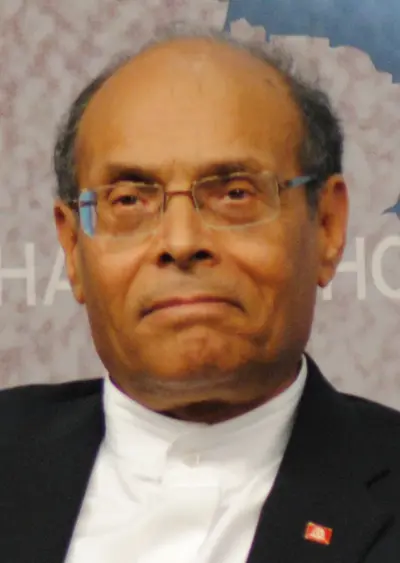
Mohamed Moncef Marzouki is a Tunisian politician who was President of Tunisia from 2011 to 2014. Through his career he has been a human rights activist, physician and politician. On 12 December 2011, he was elected as President of Tunisia by the Constituent Assembly.
