Garrison Keillor Quotes
My ancestors were Puritans from England. They arrived here in 1648 in the hope of finding greater restrictions than were permissible under English law at that time.
Keillor, Garrison. Lake Wobegon Days. Viking, 1985.


Ingersoll was considered to be the greatest orator and political thinker of his day, but his overt atheistic views curtailed his elected political career.

Both Puritans and Quakers were persecuted and physically abused in England by the Anglican Church. The Puritans as soon as they became dominant in part of the American colonies began persecuting Quakers. The Quakers who were the majority in the Pennsylvania colony, however were tolerant of other religions. This history was another of the many reasons the Founding Fathers wanted no established church. A “scorpion” was a type of whip that was particularly painful.

James was a Catholic King and did not like Protestants but positively detested Puritans. He made good his and “harried them out of the land” much to the benefit of the American colonies to which they immigrated and the detriment of England. Many of the immigrants to America came for the religious freedom, but in the early days, no sooner did they arrive and become the majority, than they began to discriminate against other religions.

Note that in addition to getting rid of the authority of the King, New York—over a decade before the Bill of Rights and the First Amendment, provided for a ban on an established church or favoring one Christian sect over another. Even then New York was a multi religious and multi ethnic society with its strong Dutch tradition along with the English tradition. New York did not go as far as the First Amendment would do later in terms of freedom of religion. NY only mentioned Christian sects. However they did implement separation of church and state and an establishment clause. See {621429} for another clause that ensures separation of church and state.


This was in effect a “Real Estate Promotional Document. Unlike the New England colonies the Carolinas had freedom of and from religion right from the beginning and it was used as an advertising point to get colonists. See {611573} and {611571} for other “features.”


This is a particularly interesting historical quotation because it succinctly gives a history of the various horrors of religious strife in British history—a history that was very well known to the American Founding Fathers and the general American Colonial population. This history was the major driver behind the public insistence for the Bill of Rights and the 1st Amendment which erected a wall of separation between church and state with government never favoring or abetting any particular religion.

New Ross was under siege by Cromwell and his English Parliamentarian troops. After two days, the town tried to negotiate terms of surrender and one of the main things they asked for was freedom of religion to practice Roman Catholicism. This famous response set the stage for religious bigotry over the next years. Cromwell’s reasons for not allowing Catholicism to be practiced was not only one of religious zeal. At the time, the Roman Catholic Church was a major geopolitical power under a Pope who commonly supported or even dispatched troops for geopolitical and religious ends. The Vatican was particularly resentful of England for separating from the Church and asserting that the King of England was the head of the Church and not the Pope. Therefore Cromwell and many Englishmen had to deal with the reality that every practicing Catholic in the realm was a potential spy, traitor, and/or rebel. This fear of control of countries by the Pope strongly affected America, and was responsible for the defeat of the first Catholic Presidential Candidate, Al Smith. It was also a major factor in the election of John F. Kennedy so he dealt with it head on.


John Witherspoon, a Presbyterian minister with evangelical sympathies, was one of the signers of the Declaration of Independence.


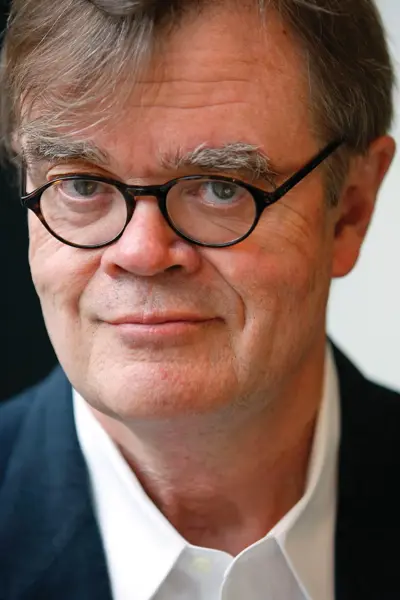
Gary Edward "Garrison" Keillor is an American author, storyteller, humorist, voice actor, and radio personality. He is best known as the creator of the Minnesota Public Radio (MPR) show A Prairie Home Companion (called Garrison Keillor's Radio Show in some international syndication), which he hosted from 1974 to 2016. Keillor created the fictional Minnesota town Lake Wobegon, the setting of many of his books, including Lake Wobegon Days and Leaving Home: A Collection of Lake Wobegon Stories. Other creations include Guy Noir, a detective voiced by Keillor who appeared in A Prairie Home Companion comic skits. Keillor is also the creator of the five-minute daily radio/podcast program The Writer's Almanac, which pairs one or two poems of his choice with a script about important literary, historical, and scientific events that coincided with that date in history.
