Anjem Choudary Quotes
Muslims who convert to Christianity are not protected. That carries capital punishment. He would be given the opportunity to repent, and the Sharia court would need to determine if he was really a Muslim in the first place, did he know what he was doing, and once all of that has been determined, there is capital punishment for that in Islam.
Kugel, Allison. "An Interview with Radical Muslim Cleric, Anjem Choudary." PR.com, 14 Mar. 2011.


Abdul Rahman, Afghan citizen, had converted from Islam to Christianity 16 years before. Conversion from Islam is a capital crime under Sharia Law which was the law of Afghanistan even after the Taliban had been overthrown. He was jailed and threatened with death. Statements like this and others made directly to the government persuaded the Afghan politicians to go against their mullahs who demanded the death penalty as is proscribed by Islamic Law—Sharia. The judges tried to get Rahman to recant and he would not (see {589518}). So they finally decided that he must be mentally insane and therefore could not be tried, and the problem was solved that way.


Quintus Septimius Florens Tertullianus

Abdul Rahman had converted from Islam to Christianity 16 years before. Conversion from Islam is a capital crime under Sharia Law. Rahman was charged but the judge demonstrating the tolerance of Islamic law said that Rahman would be given an opportunity to change his mind and re-embrace Islam and if he did so, he would be converted and not killed.

See {586039} for a quotation that goes further and seeks to punish and humiliate the non believers. This sura is often used by those wishing to illustrate the intolerance of Islam—especially of other religions. They fail to put this into the context of the Old Testament which proscribed death for heretics or the history of Christianity regarding the murder of nonbelievers. The difference is however, that a very small proportion of Jews or Christians today believe in following Biblical instructions in this respect while the proportion of Muslims who believe in the literal interpretation of scripture on these points is much larger. However there are Islamic modernists and moderates throughout the world who reject this notion of warring on all other religions and there is a struggle going on within Islam itself.

Since Muslims try and convert others, one who changes religion and becomes a Muslim is exempt. The death penalty is reserved for Muslims who leave the religion.

While this hadith has been used to justify murdering converts or even those who criticize actions taken in the name of Islam, this statement should be seen in historical context whereby Christians also commonly murdered “heretics,” and during the Protestand reformation, both Catholics and Protestants routinely murdered not only converts from their faith, but non believers such as Jews and Muslims. The Old Testament also advocated death for heretics.
In the early stages of Islam, Muhammad had hoped to convert the Jews and others on the Arabian Peninsula. When they refused to be converted, he warred against them usually killing the men, and taking the women and children as slaves. The result was that non-believing tribes were “cleansed” from the Arabian Peninsula. The Muslims at the time preferred children as slaves. For then they could convert the children against their will. Adults in Islam must accept Islam in order to convert. Children are regarded as having no such maturity of decision making and therefore opposition to conversion may be ignored and they may be forced. Critics of Islam and those who argue that Islam is at odds with all other religions point to this quotation. They claim that it is the only religion whose founder and fundamental scriptures demand war against others for no other reason than that they believe in a different religion. The Catholic Church during the Crusades and the Inquisition had a similar philosophy as did Christian missionaries colonizing Africa later. One difference is that most Christians today repudiate the doctrine as against the true spirit and teachings of Christ and view it as historical error, while very few modern Muslims repudiate this quotation of the Prophet.


Henry of Navarre. The practice of kidnapping children from parents of the other faith and baptizing them was rampant.
In one of the historical ironies of the 12th century, a Christian sect preferred the rule of the Muslims than their Christian brethren—on the grounds of religious tolerance. It illustrates the changes that take place over time. By the 21st century, it was the Christians who were thought of as tolerant and the Muslims as the opposite.

Like the other people’s of the ancient world, the Jews on several occasions murdered captives and pillaged cities who had resisted them, there was never an occasion where captive peoples were forced into Judaism or denied the worship of their customary religion.

Constantine the Great. This is one of Constantine’s major defenses of his decision to adopt Christianity. Scholars today still argue as to what part practical politics played in Constantine’s conversion and what part was his personal religious conversion.

Williams was the first theologian who not only advocated religious toleration but argued that Christianity demanded it and the separation of church and state.

There were times and places where the Ottoman Turks forced Islam upon conquered peoples. However, much of the time, they operated with a pragmatic tolerance so that they could govern smoothly. The non-Muslims were always second class citizens however. See {635095} for another example.
Damn this world, Damn this time. Damn this fate That uncivilized Arabs have come to make me a Moslem
This is a huge epic poem that he wrote over several years. At the time, the Persians considered themselves far more civilized and sophisticated than the Arabs who were but tribesmen. They really resented the fact that it was the Arabs that brought Islam. And before, most of the Persians worshipped Zoroaster. Although Islam spread faster and further than any religion in history, it was not always easily accepted as this stanza of the poem indicates. There is to this day a superiority that the Iranians perceive over the Arabs. And to this day, many Arabs resent the Iranians for this attitude.

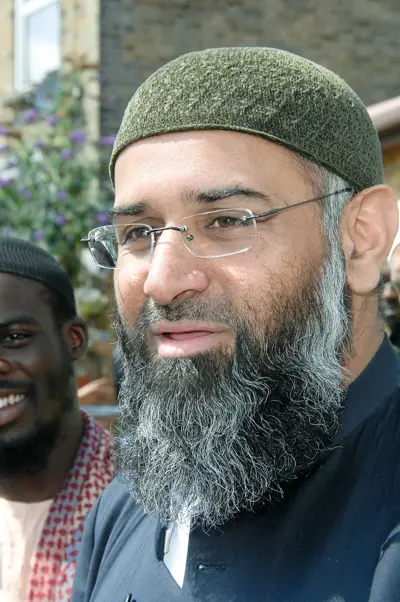
Anjem Choudary is a British Islamist and a social and political activist convicted of inviting support for a proscribed organisation, the Islamic State of Iraq and the Levant, under the Terrorism Act 2000. He was subsequently subject to sanctions by both the U.S. State Department and the U.N. Security Council freezing his assets.
