Michael Polanyi Quotes
Millions are spend annually on the cultivation and dissemination of science by the public authorities who will not give a penny for the advancement of astrology or sorcery. In other words, our society is deeply committed to beliefs about the nature of things, beliefs which are different from those to which the early Egyptian or Aztec civilizations were committed.
At the time, the public investment in science was just exploded as a result of the Manhattan Project, the effort that researched and built the first atomic bomb. By the end of the 20th century, a period of a little more than 50 years science research was funded in the billions of dollars and even correcting for inflation, the investment (Federal, State, and Local) had multiplied many fold.
Michael Polanyi, 1891–1976, Hungarian born polymath, (Chemist, Economist, and Philosopher), Science, Faith & Society, 1946
Sourced by: Eigen's Political and Historical Quotations


The vast majority of public funding for science is decided upon by peer review by scientists themselves. The government officials do not make most of the decisions. They rely on panels of scientists. The reason some of Venter’s early ideas were not funded was that the majority of scientists did not think Venter’s research was a good bet. Venter however is one of those scientists whose ideas have been very unorthodox and his great strength is that he does attack problems in unusual ways and he has had a number of major scientific breakthroughs. Venter is very persuasive and has found it easier to convince businessmen to fund him than the scientists who sit on the government science panels. However, American government money has funded many of the major breakthrough’s of our society including, manufacturing with interchangeable parts, railroads, the telegraph, computers, atomic energy, and the Internet.


It was not very long before there was no scientific field any longer in which any human being could learn everything that is known. Sherrington was one of the first to see that coming.

This is why the American Government has played such a major role in most of the great technologies in American History. Interchangable Parts (A federal contract with Eli Whitney), Canal Construction (New York State built the Erie Canal), the Railroad (federal government gave hugh tracts of land to build the rail lines to the West), the Telegraph (No one would use it until the government financed the experiment to prove it by creating a line between Baltimore and Washington), AC Electricity, there the city of Rochester NY hired Tessler and Westinghouse to Demonstrate Generating Electricity at Niagra Falls and transmitting it over 20 miles which Edison’s Direct Current could not do), immunization (the Army Medical Corps gave the first grants to universities to develop the science of vaccines and immunization, the computer (in WWII the U. S. financed the development of computers sent to England to implement Turing’s breaking of the German “unbreakable” code), atiomic energy (the Manhattan Project—the largest scientific endeavor the world has known), the Internet (Developed with long term research funds for DARPA the future technology research arm of the Defense Department. American investors and businesspeople took each of these and developed them but the initial steps, when no capitalist dared risk on such basic and futureistic efforts were taken by American Government which probably could never have developed these technologies but the private sector could not do it with government in the role Moritz herein describes.

For many people, especially, bright and educated people, science has been an escape from unstable, political situations.

The Science Guy. Explaining one of the benefits of investing Federal Funds in space research.


This is a noteworthy quotation because it illustrates—to a slightly exaggerated degree—a major difference between the public and private sectors. However, Conrad fails to point out that when government does try and establish several competitive programs and approaches, conservatives like him are the first say that the government officials do not know what they are doing and then they object to the “duplication” and “waste.” Further, usually, when a government entity does experiment as the private sector competitive system does, it is chastised by liberals and conservatives alike for having had attempts that failed or did not succeed well. Experimenting requires a cultural tolerance for failure or imperfection. Only very courageous executive politicians like President Franklin Delano Roosevelt have been able to initiate many programs aiming at the same objective with the society keeping the best—like Social Security and rejecting the worst like the National Recovery Administration. See {631419} for his view.


This view is one of the reasons that scientists have often been at odds with governments and religions.

The $2 Billion was enormous at that time—the equivalent of $26 Billion in 2010 dollars. This was the first time that all but a handful of Americans knew of the huge sums that had been invested in the Manhattan Project. What made the quotation even more memorable is how President Truman, who himself had only learned about the Manhattan Project with the death of President Roosevelt, framed the event—as a contest between us and Germany as to who would build an atomic bomb first. Actually, although almost no one in the US government realized it then, the Germans had NO PROGRAM of nuclear weapons development at all. Hitler did not trust the Theoretical Physics and Theory of Relativity because Einstein and other Jewish scientists had been instrumental in its development. He derogatorily referred to it as “Jewish Science”. Germany bet its scientific efforts on the V2 Rockets and the Jet Airplane, both of which they were successful with but too late to have any material effect on the war. Ironically, even after most of the great German physicists were run out of Germany, there were still two of the greatest who may well have been capable of nuclear weapons development. But neither Werner Heisenberg or Otto Hahn were inclined to engage in that kind of research, and neither of them were even asked whether or not they thought it was possible. The anti-Semitic Nazis just assumed that it could not be. Truman and his associates did not find out for another year or more that there was no laboratory race. There was one OSS spy, Moe Berg, who had actually talked to Heisenberg in the midst of the war, and concluded that he not only was not working on an atomic bomb, but was not up on the latest pre-war critical research needed to develop a bomb. Hahn knew and had created the first chain reaction for which he later won the Nobel prize but he was a chemist and didn’t really understand the Physics and mathematics involved in making a weapon and was a confirmed pacifist. Ironically, his colleague, Lise Meitner who had done the physics and mathematics on that experiment was Jewish and had to flee Germany. In Denmark she gave the results to Niels Bohr, who shared then with Leo Slizard and Einstein when Bohr came to the United State and that initiated the famous letter that was sent to FDR which triggered the Manhattan Project. The German first nuclear reaction was used by the Americans because the politicians listened to the scientists, while in Germany, the politicians gave no credence to their scientists and their experiments in nuclear fission.

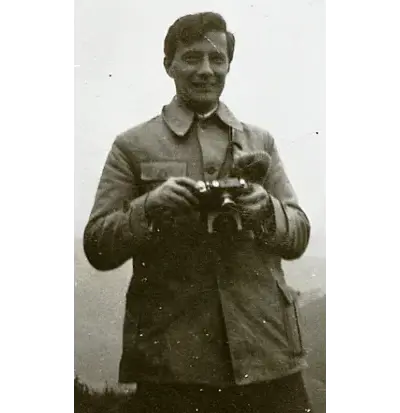
Michael Polanyi FRS was a Hungarian-British polymath, who made important theoretical contributions to physical chemistry, economics, and philosophy. He argued that positivism supplies a false account of knowing, which if taken seriously undermines humanity's highest achievements.
