John Quincy Adams Quotes
Keep what is yours, but leave the rest of the continent to us.
Adams was Secretary of State at the time.
John Quincy Adams, 1767-1848, 6th President of the United States (Independent, MA), Statement to British Ambassador Stratford Canning, January 1821
Sourced by: Eigen's Political and Historical Quotations


The meeting included several Indians, President Grant, and the Secretary of the Interior and the Director of the Bureau of Indian Affairs. The Indians had been offered $25,000 and land in the Oklahoma Indian Territory in exchange for moving from their traditional lands.

The century to which he was referring was the 19th century---1800-1899.

They were corresponding about the anti-Chinese movement in America and the attempt to exclude Chinese from immigration to the United States and ethnically cleanse the country.

Paine was describing the conquest of England in 1066 by William the Conqueror.
A very passionate minority of India’s Muslims demanded a separate Islamic State (that would become Pakistan) but Hindu’s and Muslims were mixed throughout India and many Indians and British were concerned that there would be a bloodbath if the plans for independence went forward. When the decision had been made to partition India, Radcliffe had the unenviable task of deciding where the boundary was to be between Pakistan and India. No one on either side was satisfied with his effort. So, realizing that violence was about to break out, he packed quickly and went back to England. Over two million Indians were killed in the violence that broke out in the next weeks as there was a huge migration and ethnic cleansing to implement Radcliffe’s boundaries. Fifty years later, both India and Pakistan acknowledge that Radcliffe did a very reasonable job.

5th Earl of Rosebery


This was passed in 1787 before the Constitution had become operative, but was then ratified by Congress in 1789. It was one of the first acts of our new nation, and one of the most frequently violated throughout our history.
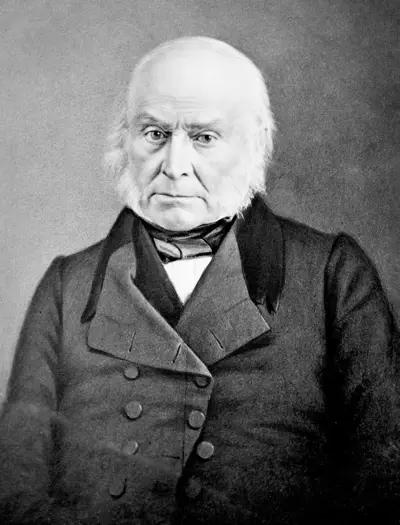
John Quincy Adams was an American statesman, diplomat, lawyer, and diarist who served as the sixth president of the United States, from 1825 to 1829. He previously served as the eighth United States Secretary of State from 1817 to 1825. During his long diplomatic and political career, Adams also served as an ambassador, and as a member of the United States Senate and House of Representatives representing Massachusetts. He was the eldest son of John Adams, who served as the second U.S. president from 1797 to 1801, and First Lady Abigail Adams. Initially a Federalist like his father, he won election to the presidency as a member of the Democratic-Republican Party, and in the mid-1830s became affiliated with the Whig Party.
