Russell Shorto Quotes
It’s true the Puritans themselves fled intolerance, but once they established themselves in America, they set up their own brutally intolerant regime.
Russell Shorto, Historian, “All Political Ideas Are Local,” New York Times Magazine, October 2, 2005
Sourced by: Eigen's Political and Historical Quotations

Both Puritans and Quakers were persecuted and physically abused in England by the Anglican Church. The Puritans as soon as they became dominant in part of the American colonies began persecuting Quakers. The Quakers who were the majority in the Pennsylvania colony, however were tolerant of other religions. This history was another of the many reasons the Founding Fathers wanted no established church. A “scorpion” was a type of whip that was particularly painful.


He commonly incites Muslims to violence against other religions which he believes totally false. Therefore, in his interpretation of Islam, it is the obligation of Muslims to kill the heretics and blasphemers. See {620307}. He was one of the leading inciters of the Bali bombing which killed so many tourists. Notice the classic attempt to first dehumanize the people who are to be the targets of violence and atrocities to overcome the normal inhibitions of most humans to do violence to another.


Odo of Chatillon-Sur-Marne. This is an amazingly distressing quotation for most moderns. Here we have the Pope preaching genocide and ethnic cleansing. This was one of the main triggers of the bloody Crusades and is not forgotten by Muslims in the Middle East Today. As Islam has not changed a great deal in 1000 years, most Muslims assume that the same is true of Christianity and especially the popes and the Roman Catholic Church. This is one of the reasons that the Islamic world reacts so strongly when a pope makes any statement negatve about Muslims and Islam.


Spinoza was one of the most feared intellectuals in human history—feared that is by the established power structures. He is the only known person who was excommunicated by the Catholics, the Jews and the Muslims—all were forbidden to read his works. He was the enemy of authority and advocated personal reason as the guide for men.
Bashir advocates adapting Sharia—Islamic Law—for all people in Indonesia—regardless of their religion or their preference for separation of church and state. This is diametrically opposite to an Islamic Syrian poet of 1000 years ago—see {624477}. Many Muslims have become more intolerant than some of their earlier scholars. Bashir also differs from most Indonesian Muslims who have historically not shared his bigotry and intolerance.

Samuel Langhorne Clemens, 1835-1910


_0_thumbnail_47x47.jpg "Statue of Robert Hall in Leicester.")
Many of the founding fathers were aware of such views in England as the same issues were being debated in America in the debates on Ratification of the Constitution and the required inclusion of the Bill or Rights—specifically the First Amendment.
Toleration is a relative term. The Muslim Moors made Christians (and Jews) pay a special tax. At times they were forced to wear special clothing so that they could be readily identified. And they could not build churches larger or taller than the smallest mosque in the community. At times, their occupations were restricted but at other times Christians and Jews were appointed to the highest positions like Vizier. The Inquisition, in contrast, forced all Muslims (and Jews) to leave the country without any of their property or money or be tortured and killed—usually by burning at the stake unless of course that they converted to Christianity.

Like Protestantism, there are different sects of Judaism but not so many. The Reform Jews are the most modern Jewish religious group. Reform Judaism originated in France and developed in America in the 19th century, and most American Jews belong to this branch of Judaism. In Israel, the Reform Jews are a minority like the ultra-Orthodox of which this Rabbi was a leader. He was the head of the ultra-Orthodox Shas political party which often has substantial political power when the two major parties do not have enough votes to make a majority and they need Shas as a coalition partner. This minor party often has a great deal of political influence. Religiously however, Shas speaks for a small minority of Israelis. However, they and some other ultra-Orthodox have been able to control or be very influential with the Israeli Ministry of Religion and they have used this power to not give Reform Judaism any official recognition. Reform Rabbis—which include women—are not officially recognized in Israel and so far as this Rabbi and many of his followers are concerned, Reform Judaism is a great danger to Jews and Israel. The hatred, as in this quotation, for the Reform Jews, is greater than any animosity for the Arabs. In actuality, this rabbi and his followers, are culturally and religiously very much like the Muslims. As Sephardic Jews, they have grown up in the Middle East and before Israel’s founding, they lived in Islamic counties and absorbed much of their culture. Like ultra-orthodox Muslims, they believe in theocracy and oppose democracy. They oppose religious freedom, and oppose civil law and civil courts in favor of religious law and Rabbinical courts. See {637098} for their hostility to the Supreme Court. The friction between the secular, Reform and most Jews in Israel and the ultra-Orthodox simmers just below the surface and breaks out every so often, but the pressure to refrain from major political strife is great lest there not be enough of a united front to protect the Jewish people from the extremists in the Middle East who want to nullify the Israeli state by force and would threaten the very lives of Jewish people.


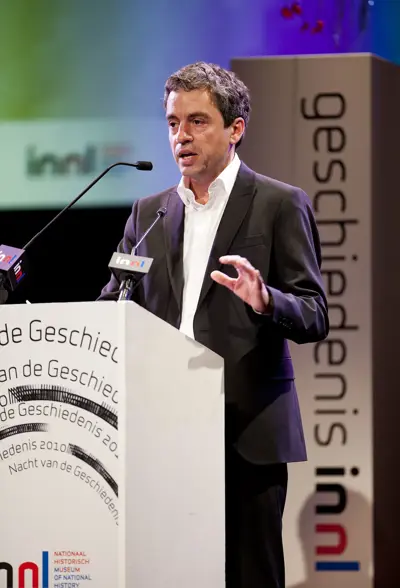
Russell Shorto is an American author, historian, and journalist who is best known for his book on the Dutch origins of New York City, The Island at the Center of the World. Shorto's research for the book relied greatly on the work of the New Netherland Project, now known as the New Netherland Research Center, as well as the New Netherland Institute. Shorto has been the New Netherland Research Center's Senior Scholar since 2013.
