Vandana Shiva Quotes
It's a phenomenon that started in the United States in which corporations make claims on the life forms, biodiversity and innovations of other cultures by applying for patents on them.
Shiva, Vandana. Biopiracy: The Plunder of Nature and Knowledge. South End Press, 1997, p. 5.


Tonga has 100,000 people who have been relatively isolated for centuries and hence have a more uniform gene pool than most parts of the world. As such it makes a wonderful resource to identify the causes of many diseases including and especially those that are more prevalent amongst Tongalese. In the early 21st century, an Australian genetic engineering company, had entered into an agreement with the Tonga Health Ministry to conduct studies. Tonga, a monarchy with the King all powerful, had a small democracy movement, who objected to the entire form of government, and was particularly incensed that the Government would make such an arrangement with no public debate or national discussion. Many years ago, Australian interests have came to Tonga and traded for Sandlewood—at what some critics saw as “giveaway” prices.
Many people believe that patents—especially in the high technology arena—actually inhibit innovation.


He worked for General Electric for over 40 years and held 322 patents. However, it was the corporation that financially benefitted from the monopolies granted by the patents. Our legal system assumes that the creative output of an individual who is an employee is the property of the employer just as the output of the slave was the property of the master.
In the early years of our nation, there was not much intellectual property being developed in America. We were an underdeveloped nation, and we took whatever we could get regardless of laws. Alexander Hamilton for example urged obtaining industrial trade secrets and even machines by whatever means was necessary. However in the latter part of the 19th century, Nathaniel Hawthorns, Mark Twain and other creative Americans persuaded the government to join copyright conventions; we had become the victim of intellectual piracy rather than the pirates. Then we became the leading nation in advocating and enforcing intellectual property rights. This coincided with our becomng the leading producer of intellectual property. Intellectual property rights has always been an issue of “whose ox was gored.” The US position is somewhat hypocritical given our early history. However, respect for intellectual property rights, we now argue, in our modern global economy will encourage businesses to not only invest in developing countries but allow their technology and trade secrets to be used in the developing nation.

Note that the only reason given in the constitution for protecting intellectual property was to promote the progress of science and useful arts. Inventors, would keep secret their inventions and techniques of manufacture and use in order to protect their economic interests. No one else would be able to benefit by understanding the invention and taking it further and increasing knowledge and understanding. So the Founding Fathers told Congress to establish a system where inventors would get a guarantee of a reasonable time to profit exclusively from the invention in exchange for making the invention public. The plans, methods and drawings had to be made public and until the 20th century a model of an invention had to be supplied to the Patent Office. Anyone could get an inexpensive copy of any patent and come and study the models. Today, most people believe that the reason for a patent system is to protect the intellectual property of the inventor, but that was not a purpose or even a serious consideration. The reason however was educational and to demystify technology and produce more science and technology which it did.
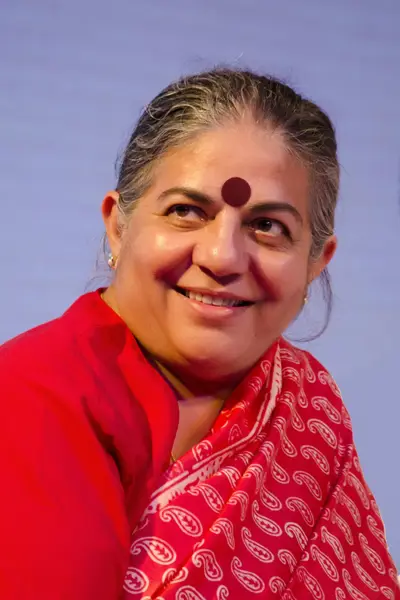
Vandana Shiva is an Indian scholar, environmental activist, food sovereignty advocate, ecofeminist and anti-globalization author. Based in Delhi, Shiva has written more than 20 books. She is often referred as "Gandhi of grain" for her activism associated with anti-GMO movement.
