Pope Pius II Quotes
It will be your destiny to defend Christendom against the Turk. It will thus be an essential part of Your education that you be early taught the use of the bow, of the sling, and of the spear.
Aeneas Sylvius Piccolomini. Early in his career, as Secretary to the Emperor, he was assigned to oversee the education of the young king of Bohemia.
Pius II, 1405-1464, Roman Catholic Pope, Italian Secretary to the Emperor Frederick III, To Ladilas, King of Bohemia, De Librorum Educatione
Sourced by: Eigen's Political and Historical Quotations


Christians of 1 thousand years ago were barbarous and immoral compared to Christians of today, even though their Bible is the same. He argued that Islam may well also reform. In looking at Islam compared with Judaism, Christianity, Hinduism and Buddhism, it is useful to remember that these are much older religions than Islam. They have had more time to reform and develop. Compare Christians 700 years ago to Christians today. They were pretty barbaric in comparison. They burned heretics at the stake and "witches" also. But Islam is 700 years younger than Christianity and thousands of years younger than the other 3 religions mentioned. It may well need more time to develop and reform.
Different Christian European powers moved in and out of alliances with each other and with the Islamic Ottoman Empire. So Christians were not unified and whenever a Christian country was at war with the Muslims some Christians perceived it as an assault on Christianity—except that there were Christian allies of the Muslims. Later many Muslims would see any conflict with a Christian country as an attack in Islam even when Muslim nations were allied with the Christians as was Turkey at the end of the 20th century. Turkey was a member of NATO and was therefore seen as traitors to Islam by some Muslims. There has always been this tendency to see conflict in terms of religious or ethnic hostility where convenient.

In addition to the Muslim world during the Crusades losing control of the Holy City for the first time in 400 years, the Christians stabled their horses on the Al Axa Mosque and the Dome of the Rock, two of Islam’s holiest places. In addition, the Crusaders, after taking the city, slaughtered most of the inhabitants—Muslims, Jews and even fellow Christians who were Eastern Orthodox—more than 30,000 in just a day or so. It was a reign of terror on a scale that even today, it is shocking to most. So where as to us the Crusades were an interesting of aberrant part of history, to many Muslims of the Middle East the thought or discussion of the Crusades is traumatic even today.
When the Turks defeated the Christians, the only explanation many Christians could conceive of was that God was on the side of the Turks.


See {582893} for Saladin's Reply. King Richard was the leader of all the Christian forces in the Holy Land for the Crusade. There was a belief, that a wooden cross in the possession of the Muslim force was the true cross of the Crucifixion of Jesus Christ

The Bull was directed at French King Louis VII. On Christmas Eve the year before Zengi had broken into the city of Edessa and massacred the French inhabitants. This was the Proclamation of the start of the 2nd Crusade. Note that the Pope, in order to raise troops and money for the Crusades, used the remission of previous sins to motivate Pietro dei Paganelli di Montemagno
Winston Churchill utilized this quotation in his first radio address as Prime Minister, May 19, 1940

As in modern times the Navy encouraged the media and leading writers to promote their latest weaponry. Hawthorne however shortly after the Monitor and the Merrimac battle saw the future in terms even more dramatic than most of the military.


The Papacy was at one of it’s lowest points. Two men, Clement and Urban, both claimed the Papacy and each had raised an army to fight the other. Each was promising indulgences to those who would fight, and in a modality similar to the Muslim terrorists of the 21st century, the soldiers were promised ascendancy to Heaven if they fell in battle for such a holy cause. The armies of the popes marched under the cross as their banner, and Wycliffe found that obscene and actually wrote a treatise saying so. See {618087}.


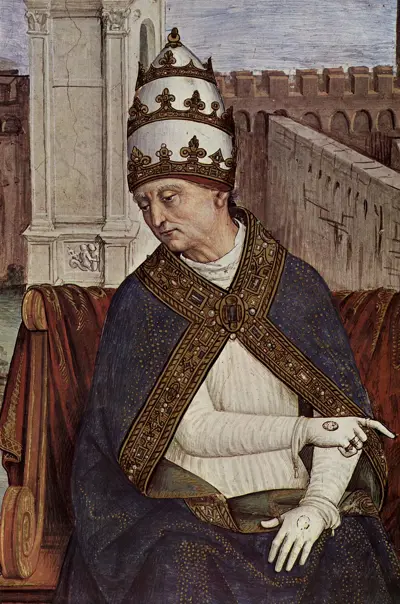
Pope Pius II (Latin: Pius PP. II, Italian: Pio II), born Enea Silvio Bartolomeo Piccolomini, was head of the Catholic Church and ruler of the Papal States from 19 August 1458 to his death. He was born at Corsignano in the Sienese territory of a noble but impoverished family. His longest and most enduring work is the story of his life, the Commentaries, which is the only revealed autobiography ever to have been written by a reigning pope.
