Nicholas Kristof Quotes
It is very easy for whites to miss problems that aren’t our own; that’s a function not of being white but of being human.
Nicholas D. Kristof, Political Columnist, “When Whites Just Don’t Get It”, New York Times, November 30, 2014
Sourced by: Eigen's Political and Historical Quotations

_0_thumbnail_47x47.jpg "American stage actress Sarah Jones")


This quote illustrates the Southern segregationist view in the Jim Crow South.


Instead of standing and saluting as professional athletes have done for decades before games, he kneeled and refused to stand. This caused great public criticism but also some initial support. He was potentially risking his multimillion dollar salary as this technically violated his contract to avoid anything embarrassing to the team. He also donated $1 million to programs in the area that were working to enhance Black/white understanding. Even those who disagreed with his choice of protest defended his right to do so, and after the initial furor, public opinion, while not in agreement about his method, tended to support him for having the courage of his convictions and using his celebrity for a worthy cause. After sensing the public opinion, his team matches his $1 donation. Professional athletes both in the NFL and in other sports then began to do the same as a form of protest for the large, disproportionate, number of black men who were killed, mostly when unarmed, by police. The reference to the “paid leave” was the practice followed by most police departments—usually required by collective bargaining agreements with police unions—of placing police officers accused of committing violations of laws or regulations on paid administrative leave while all the investigations, hearings, and other processes . While this practice protected the rights of those police officers who were not guilty, it ended up paying brutal murders for a some time entire their case was decided or acted upon be the district attorney.

This is one of many instances where Black leaders advocated armed self-defense. In the early 20th century, this worried whites who often accused these blacks of advocating violence against whites. It also made non-violent, anti-gun, blacks, like Booker T. Washington, more popular.


This was a quotation from Roof's twisted confession of the fact that he walked into a black church that was holding a Bible Study Class, and gunned down 9 religious people studing the Bible. His "justification" was based on totally false "facts" but at the time many people--especially those and the extremes of political ideology simply chose the fact that supported their narrative and world vie without regard to veracity. The overwhelming majority of whites who are murdered in America are murdered by other whites and usually by people whey knew. Most rapes in the United States are committed by Whites, not Blacks, Of the Black committed rapes, most of the victims were also Black. Large proportions of the American populace believe that the Black cntribution to crime against whites is very much larger than it reall is. Of the whites who believe this, a tiny few become white supremicists and only some of those act out and commit any physical violance. However the few succetable people like Roof have heard these falsehoods so ofteh that tney not only beleive it si try but they believe taht they must do something lest the problem get worse. Of course, even if Blacks were committing all these crimes against whites, it takes a spcially sociopahic mind to believe that by killing Bible-studying, deeply religious, Christian Blacks, they will somehow stop violent Black crime.


The president was commenting on a Donald Trump campaign statement that African American were in the worst shape in history when the reality was just the opposite

Moynihan was an Assistant Secretary of Labor at the time. At the time politicians did not overtly discuss the racism that had, did then, and still does permeate the American culture. Segregation had just been made illegal but was still rampant. Many whites were highly insulted by this paper. Most Blacks were outraged at Moynihan's general thesis. So the report offended many.


_0_thumbnail_47x47.jpg "The psychical researcher William McDougall.")
This quotation illustrates the extreme distortion of even observed evidence that many racists of the early 20th Century went through. Mcdougall was a Harvard professor and was familiar with the intellectual accomplishments of a number of Blacks including W. E. B. Du Bois who also was a Harvard man who was even superior to most whites at that institution. However his racial ideology could not possibly allow that Negroes could be as accomplished as some of them was. His “creative” explanation given here is that all accomplished Blacks must have had white blood, because only white blood could produce such genius. Note also the emphasis that he places on the historical inability of Negroes to form a nation. McDougall knew little about history as there were many Negro nations created from ancient Biblical times throughs the 19th century. Shaka who not only built a Zulu nation but turned it into an expansionist empire contesting England in the Anglo Zulu Wars of the late 19th century as both entires fought to see which would colonize and dominate much of the South of Africa,

A Southern Republican congressman with a voting record that was against minority interest, for the first time in American, interrupted and insulted the President of the United States in the midst of an invited Presidential Address to Congress given by Barack Obama, calling him a liar. Carter, himself a Southerner, recognized the motivation.


Black protests and demonstrations were emerging throughout the country after a white police officer shot to death an unarmed black teenager in Ferguson, MO. This argument was made by a number of police apologist whites who could not understand the ferocity and passion of the demonstrations, but Giuliani was the most prominent politician taking that viewpoint. See {642521} for the refutation and response.


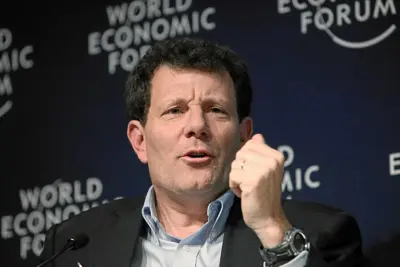
Nicholas Donabet Kristof is an American journalist and political commentator. A winner of two Pulitzer Prizes, he is a regular CNN contributor and has written an op-ed column for The New York Times since November 2001. Kristof is a self-described progressive. According to The Washington Post, Kristof "rewrote opinion journalism" with his emphasis on human rights abuses and social injustices, such as human trafficking and the Darfur conflict. Archbishop Desmond Tutu of South Africa has described Kristof as an "honorary African" for shining a spotlight on neglected conflicts.
