Muhammad Ali Jinnah Quotes
Islam expect every Muslim to do this duty, and if we realise our responsibility time will come soon when we shall justify ourselves worthy of a glorious past.
Jinnah, Muhammad Ali. Speeches and Writings of Mr. Jinnah. Edited by Jamil-ud-Din Ahmad, Vol. 1, Sh. Muhammad Ashraf, 1942, p. 102.


This text, generally considered the most important of all the Hindu works is believed to be the guidance given by Lord Krishna, the most important of the God figures, to has friend and devotee Arjuna. It originally was an episode of the enormous Mahabharata, the history of the ancient world written originally in Sanskrit. The date is approximate and different scholars have dated it from 500 BC to 50 BC. The Bhagavad Gita is generally regarded as the most concise description of Hindu philosophy. For some religions, fighting and war is not only permissible but can be a religious duty. Islam has the same notion. Christianity in contrast has had more of a theological struggle with war as a duty and even had to develop the concept of a “just war” to make fighting morally permissible. But this compunction, also shared with Buddhists and Bhai for example, is by no means universal. When religious Muslims fought religious Hindus as they have for over 1000 years, it is particularly difficult even today to make peace as so many on both sides see the battle as a religious duty.

In early Islam, scholarship and science was encouraged in all fields and in most areas the Muslims state of knowledge was greater than that of Christian Europe. However, over time the fundamentalists restricted the concept of knowledge to the Koran under the theory that anything worth knowing was in the Koran and that which was not should not be studied. In modern times Islamic nations, holding this very narrow view of education and learning, have intellectually stagnated—especially in modern science, technology, politics and philosophy. Most Islamic universities and madrasses teach only theological subjects and Koranic prescriptions of life and law and the few exceptions tend to be in strongly secular countries like Turkey.


A companion of the Prophet named Hudhayfah asked the Prophet about what the future holds for the Muslims. The Prophet replied:


“Zakat” is the practice of giving a percentage of one’s property to the poor. This is similar to the concept of tithing and charity in Christianity and Judaism. One difference today is that many of the Muslim nations use the religious requirements as an element of state policy and the social safety net is intertwined by state and church. The Mormon Church in early Utah had the same amalgam of church and state, but that was abandoned in favor of separation of church and state. Turkey went through the same shift in the Ataturk revolution.

His views are a mix of modernism and fundamentalism. He favors democracy and elections but also favored the Taliban destroying the great ancient Buddha statues when he was called an idol worshipper for urging the preservation of art. His ignorance of modern technology Is illustrated by his complaint that the Arab nations do not even “produce a single nail” for modern cars. The reality is that there are no more nails in modern cars.


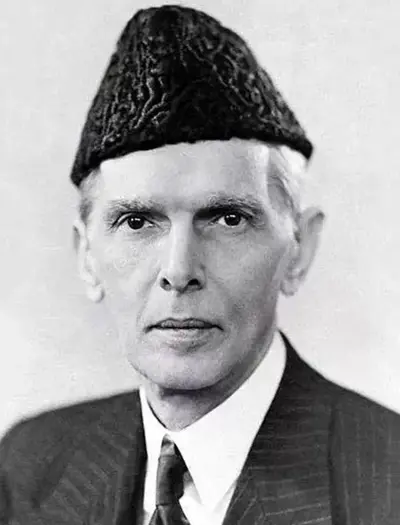
Muhammad Ali Jinnah was a barrister, politician and the founder of Pakistan. Jinnah served as the leader of the All-India Muslim League from 1913 until the inception of Pakistan on 14 August 1947, and then as the Dominion of Pakistan's first Governor-General until his death. He is revered in Pakistan as the Quaid-i-Azam ("Great Leader") and Baba-i-Qaum ("Father of the Nation"). His birthday is observed as a national holiday in Pakistan.
