George Francis Train Quotes
Is not the meager, thin, long, chop-fallen, half-starved savage, as you find him a prisoner of war in negro land, a barbarian, compared to the happy, contented, well developed, strong, hearty, well clothed, well fed, negro slave in his Christianized state of American Slavery?
George Francis Train, 1829-1904, Businessman, Promoter, and Orator, Independent Candidate for President of the United States, Speech, London, March 12, 1862
Sourced by: Eigen's Political and Historical Quotations


Contrast this view with that of Union General Ulysses S. Grant.


Brown was the richest man in Rhode Island and made much of his money in the slave trade. This quotation shows that slavery was not completely a North verses South split. Northerners like Brown for whose family Brown University was named, was as virulent supporter of slavery as the most ardent Southerner.


The language was removed in the negotiations that followed Jefferson's draft.


Miller was the first Black American admitted to a Graduate Program—Johns Hopkins—in Mathematics


Parker and other escaped slaves in Christiana fought off slave catchers and killed the slave owner leading them. Charged with treason, he escaped to Canada with his family and lived there the rest of his life. While not a polished writer, after he himself had escaped and went to Christiana and leaned to read and write. He wrote this narrative of his life as a slave—one of the few written works we have from slaves.
_0_thumbnail_47x47.jpg "A portrait of Richard Allen, a Methodist bishop and founder of the African Methodist Episcopal Church")
Many whites thought that the solution to the problem of free and emancipated Negroes was to send them to Africa. They assumed that the negroes would by desirous of that solution also, but they rarely asked them. When they did, they received answers much like this one from one of the leading Black clergymen in America.


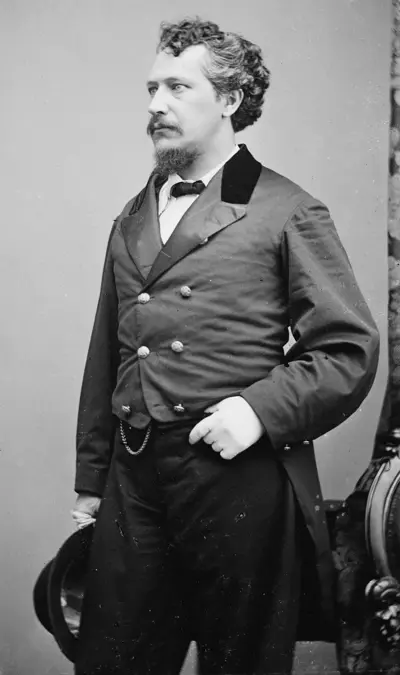
George Francis Train was an American entrepreneur who organized the clipper ship line that sailed around Cape Horn to San Francisco; he also organized the Union Pacific Railroad and the Credit Mobilier in the United States in 1864 to construct the eastern portion of the Transcontinental Railroad, and a horse tramway company in England while there during the American Civil War.
