Robert Mugabe Quotes
Is it not obvious that Britain, under the regime of Tony Blair, has ceased to respect the Charter of the United Nations?
Mugabe, Robert. Address to the United Nations General Assembly. 59th Session, United Nations, 2004.


Dulles lied to Congress. The CIA at the time was supplying planes and American pilots in support of an anti-Sukarno Government faction that was in armed revolt. It is not clear whether or not Dulles knew the truth when he had so testified.


There have been times in democracies where a foreign ministry (State Department) is isolated from the elected politicians and implements a foreign policy that is at odds with the wishes of the elected officials and the majority of the nation. A good American example of this was in 1948 where America had to decide whether to support the creation of the State of Israel in the United Nations and through diplomatic recognition. The professional diplomats in the State Department had developed very close relations with Arab States, and many State Department employees were anti-Semitic. In addition, they thought the most important thing for America was not to risk the Arab oil supply. Meanwhile, the people, Congress, and President Truman were on the other side and Truman had to finally order The Secretary of State to stop his professional diplomats from pursuing their own foreign policy preferences. Even then some did not.


The Senate refused to ratify.

The “proofs” were diplomatic assurances—treaties—that England would guarantee the territorial integrity of Belgium. The British made strong diplomatic efforts to persuade Germany not to occupy Belgium. The German’s none the less send armies in under the excuse that if they did not, the French would occupy the country and have a strategic advantage over them. Diplomacy could do no more good. England had to send troops or renege on its obligations. So England was in WWI.

There is no court structure that handles International law disputes. There are some international bodies that hear some types of international law disputes, but no general mechanism. The procedures of these few bodies are very complex and arcane. But worse, there is no body with any power that can enforce any decision that may be reached. Enforcement depends on the good will of the nations involved or the pressure that can be brought to bear by other counties.


Because the Senate has not ratified some international treaties, the United States does not participate in some international efforts to create international rules and law. The reason for non-ratification is generally given as potential loss of American sovereignty. At the same time, we spend billions of dollars trying to influence and shape the world along free market, democratic lines, and then are not able to participate in some of the most important forums where we could do just that. It is a constant dilemma and the Senate goes both ways depending on its mood, public opinion at the time and the political composition of the Senate. See {637031} and {637032}.


Some people believe that the United States pressured Pakistan to enable America to support the Mujahideen in their effort to fight the Russian occupation of Afghanistan. Actually the President (and virtual dictator) of Pakistan wanted aid from America and was offering bases. America did not want bases but did want a platform for arming and training the Mujahideen, Pakistan allowed us to use Pakistan as a platform. We increased our foreign aid to Pakistan by 500 percent. There was no arm twisting.

The Congressman was being critical of the George W. Bush Administration and their tendency to decide which leaders and countries were legitimate and moral and which were not, and then invading the “bad” and executing the leaders as with Iraq and Saddam Hussein.
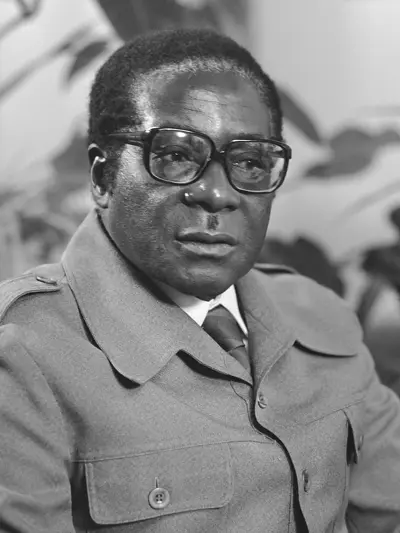
Robert Gabriel Mugabe was a Zimbabwean revolutionary and politician who served as Prime Minister of Zimbabwe from 1980 to 1987 and then as President from 1987 to 2017. He served as Leader of the Zimbabwe African National Union (ZANU) from 1975 to 1980 and led its successor political party, the ZANU – Patriotic Front (ZANU–PF), from 1980 to 2017. Ideologically an African nationalist, during the 1970s and 1980s he identified as a Marxist–Leninist, and as a socialist after the 1990s.
