John Rankin Quotes
In my boyhood a majority of the people of East Tennessee [where he was born] were abolitionists …. It was safer to make an anti-slavery speech in the South than it became during the thirties [1830’s] to make the same speech in the North.
Northern laborers, especially the new Irish immigrants, were fearful of the prospect of competing for jobs with freed Negroes who they perceived would flock to the North. That is what happened but a century later. The blanket assumption that the South was pro slavery was also not accurate. Different sociologies and economics produced different attitudes in communities throughout the South and some were inclined to abolition as Rankin’s history demonstrates.
John Rankin, 1793-1886, Presbyterian Minister in Kentucky, Founder of an Anti-Slaver Society in Carlisle, Kentucky, Quoted by J. C. Leggett, Speech, dedicating a Bust of Rankin at Ripley, Ohio, May 5, 1892
Sourced by: Eigen's Political and Historical Quotations

Later changed the name to The Emancipator. Many are surprised that a Southern State would have had such strong abolitionist sentiment so early, but East Tennessee was a hotbed of abolition. See {614117} and {614069}
When the first Southern States seceded, each appointed a whose job it was to persuade the other Southern States to also secede. In this case Hale was marketing secession to Kentucky which with Maryland were the only two Southern States to reject what they regarded as treason and rebellion. The importance of the quotation however is in his argument which was all based on enmity to racial equality and abolition. Later Southern apologists would argue that the Civil War was fought, not about slavery and racism butt about different philosophies of government. See {623715} .


While England was strongly opposed to slavery, the English textile industry benefited from importing American Southern cotton. So many in England were supportive of the Confederacy.


I should sooner remain in Southern bondage than avail myself of the opportunity of Northern freedom.
Hughes was a strong critic of the exploitation of laborers in the North by what he called the “bloated capitalist” First Irish Bishop in the United States
This editorial from an Alabama newspaper in 1856 is a wonderful illustration of the animosity held by many in the South towards the North. It also shows the major difference in egalitarianism between the North and the South at that time. The only Southerners who could read were the upper class who were terribly fearful of the effects of upward mobility of whites in a slave free industrial democracy. “Mechanics” at the time referred to all skilled craftsmen.

The reason for secession was the threat to slavery, which was a great threat to the slave-owners of the South. However, the non slave-owners had a very strong vested interest in maintaining slavery in that most Southerners had been brought up with such a negative view of Blacks that they were paranoid of Black equality or even worse some Blacks in positions of authority over whites. At the time, it was the Republican Party that was the advocate for minority equality and the Democratic Party embraced the racists. The parties would flip flop after the Civil Rights Act of 1964 ending legal segregation was passed by a Democratic President and a Democratic Majority Congress.
This marvelous quotation gives us a picture of the essence of the conflict in conception of freedom between Southern whites and negroes. There was no way to change the large majority of whites’ opinions and it is easy to see why Jim Crow and Southern discrimination evolved as it did. The emancipated Blacks had insufficient power or resources and there was not enough effort or success at changing white attitudes and no where near enough law enforcement to impose the view on the majority of the Southern white population.
What makes this quotation so historically interesting is that the abiding by the Supreme Court’s decisions on constitutionality was even an issue. It was because of the terrible Dred Scott decision which required Northern States to return fugitive slaves to their owners despite the constitutions of those states which stated that all men were free. A substantial part of the Democratic Party was the “solid South” and the return of fugitive slaves was one of the major issues of the 1860 Presidential Election. Ironically, the Southern States were arguing AGAINST states’ rights when the Northern States’ laws and Constitutions made fugitive slaves free the minute they set foot in the state.

Buchanan us considered by most historians to have been the worst or one of the worst Presidents of the United States. At this point, he was a lame duck president with Abraham Lincoln, the President Elect soon to take office. This speech, just encouraged the South more than ever and helped to bring about the Civil War. His vacillation and lack of any leadership on the slavery question exacerbated the polarization that was tearing the nation apart.

The NAACP official magazine

It was in fact, the following year when the South rebelled to prevent a “settlement”, but the irony was that the Civil War brought the settlement—emancipation-- faster and on less favorable terms than had they not rebelled and let the political process end slavery gradually as the majority of the nation wanted and morality dictated.

The Confederates were very clear that slavery was the cause of the war. Revisionists later tried to add other motives to the Southern cause, but Grant and all the contemporaries on both sides knew slavery was the crux of the matter. So the Confederate cause was the right to brutalize, torture, and even kill an unwilling labor force that was unpaid. No war in history had ever been fought for such a lowly cause and the Confederate leadership skills were amazing in keeping up morale without a decent cause to fight for.

This moral statement from a New jersey Quaker abolitionist is not particularly noteworthy, However what makes this quote important is that Woolman traveled throughout the South preaching this as his main theme. At that time — before the American Revolution — he did so and was not attacked or intimidated; he was mostly ignored by the Southern authorities. At the time, the South was very confident of its ability to continue slavery. Years later, when the abolition movement grew larger and stronger, a Northern Quaker Preacher doing this not not escape with his life.


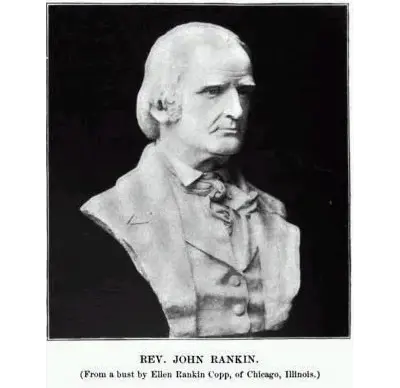
- Born: February 5, 1793
- Died: March 18, 1886
- Nationality:
- Profession:
John Rankin was an American Presbyterian minister, educator and abolitionist. Upon moving to Ripley, Ohio, in 1822, he became known as one of Ohio's first and most active "conductors" on the Underground Railroad. Prominent pre-Civil War abolitionists William Lloyd Garrison, Theodore Weld, Henry Ward Beecher, and Harriet Beecher Stowe were influenced by Rankin's writings and work in the anti-slavery movement.
