Vandana Shiva Quotes
In England, the population explosion can be linked very clearly with the enclosure of the commons that uprooted the peasants from their land. In India, it was the same thing: the population increased at the end of the 18th century when the British took over and Indian lands were colonized. Instead of the land feeding Indian people it started to feed the British empire. So we had destitution. Destitute people who don't have their own land to feed themselves can only feed themselves by having larger numbers, therefore they multiply. It's the rational response of a dispossessed people.
Shiva, Vandana. Interview by Derrick Jensen. Listening to the Land: Conversations about Nature, Culture and Eros. Sierra Club Books, 1995, p. 57.


The Romans were very organized regarding land ownership. When they conquered Africa, defeating Carthage, they found no written records of land ownership, no deeds, no bills of sale. Therefore, they opened up the entire land mass of Africa for what amounted to public colonization where the land could be worked and claimed legally. Illiterate Africans had no written records, and most areas where under the control of a strongman who “owned” all of the land with no notion of private ownership of land.

The line, like many in good poetry, has several levels of meaning. The most obvious is that we had explored and conquered the land, before we became a nation.


In Burundi, family land is divided among the male children of a family. The average Burundian woman has 6.3 children at that time, nearly triple the international fertility rate. With this population growth rate, the plots of land for each person inevitably get smaller and smaller over time. At 10,745 square miles, Burundi is slightly smaller than the U.S. state of Maryland, but it holds nearly twice as many people: about 10 million. The small plots of land are inefficient to farm and provide subsistence. So the nation was in a crises as there was little industrialization and land was essential for existence for most Burundians. See {35807} and {35808}.


Most of her modern admirers tend to repress this quotation which is very embarrassing for most modern conservatives. However, there is a minority of thinkers who maintain that land, unused, is open to anyone who will make use of it to improve civilization. Many conservationists, in contrast, extol unused land for preservation.

His idea was to send English people who were vagabonds, paupers, failures, and never do wells to America. These people in England were just “waste”. But in America, the could be apprenticed or become indentured servants, learn skill and they would (and indeed did) become the corps of laborers needed to cut down the trees, beat the hemp (for making rope), gather honey, salt and dry fish, dress raw animal hides, dig the earth for minerals, raise olives and silk, and sort and pack bird feathers. In England they were so desperate that they would work in the difficult conditions of the colonies and would be willing to venture out from the country and culture in which they existed—a major problem in getting colonial workers.


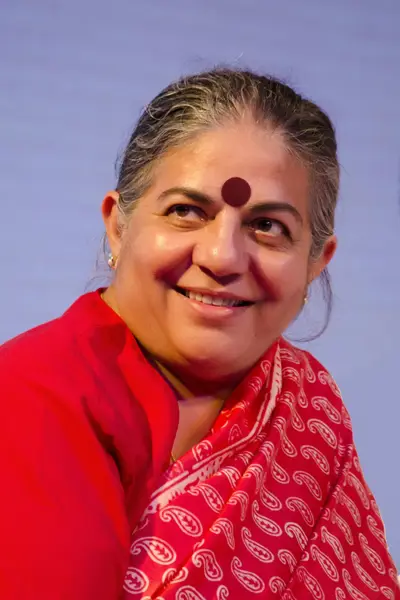
Vandana Shiva is an Indian scholar, environmental activist, food sovereignty advocate, ecofeminist and anti-globalization author. Based in Delhi, Shiva has written more than 20 books. She is often referred as "Gandhi of grain" for her activism associated with anti-GMO movement.
