Paul Jennings Quotes
In August, 1814, the enemy had got so near, there could be no doubt of their intentions. Great alarm existed, and some feeble preparations for defense were made. Comodore Barney's flotilla was stripped of men, who were placed in battery, at Bladensburg, where they fought splendidly. A large part of his men were tall, strapping negroes, mixed with white sailors and marines. Mr. Madison reviewed them just before the fight, and asked Com. Barney if his "negroes would not run on the approach of the British?" "No sir," said Barney, "they don't know how to run; they will die by their guns first." They fought till a large part of them were killed or wounded; and Barney himself wounded and taken prisoner. One or two of these negroes are still living here.
This quotation is yet another documentation of Blacks fighting and dying for America’s freedom. What is particularly interesting is that the Blacks fought as an integrated fighting unit with white sailors and marines. Most sailors and marines of the day had experience working with free Blacks many of whom served on American whaling ships and merchantmen. Working with Blacks was to them not as unusual and unheard of as typical white landlubbers would perceive. An experienced sailor, Commodore Barney had also likely commanded Black sailors before. Ironically, segregation of the navy and discrimination would become much worse as the politics of Reconstruction played out in America.
Paul Jennings, 1799-?, Former slave of James Madison who, after he purchased his freedom, worked in the Dept. of Interior and then the White House when Madison was elected President, A Colored Man's Reminiscences of James Madison
Sourced by: Eigen's Political and Historical Quotations

He drove the British into the sea when no one expected that outcome.

In the attack on Fort Wagner, the color bearer was killed as was the Commanding Officer, Colonel Shaw. Carney raised the flag and led the men up the sand wall into the Confederate midst. They were vastly outnumbered and then retreated. Carney was the first Black to win the Medal of Honor.
Colonel Banks had given him the Regimental colors flag and urged him to take care to return it with honor. This was his famous reply. In the midst of the Battle he was hit fatally with a cannonball. A Black corporal then took up the colors and he too was killed and yet another Negro corporal took the flag and returned it after a battle where the Blacks were commended for their valor. This quotation has been quoted to military men and women throughout the world as an outstanding example of military bravery and honor..

He had been asked by a reporter if his Marines would be able to take Baghdad in the American invasion of Iraq, 2007. Kelly commanded the Marines charged with taking Baghdad. They did.


Despite the critical need of the war, racism was so extensive in the WWII military that Blacks were relegated to menial duty of cooking, truck driving and construction but were actually not allowed to fight at the beginning despite the fact that many had volunteered. Many whites—especially the southerners—were convinced that Negroes could not fight, that they lacked the courage and commitment. The need for troops in the Pacific theater was so great that in the invasion of Saipan that was so difficult, Black troops were committed to the fight and performed brilliantly. The Commandant of the Marine Corps, General Vandergrift was not only the first Marine 4 star general who was on active duty, but he personally was a recipient of the Medal of Honor. When he spoke, all marines and many others in the service listened. This was the break-though. Negroes in combat was no longer some kind of social experiment for most Marines except the most vitriolic rascists.


This Civil War recruiting poster was described by the Free Library of Philadelphia as “Civil War recruitment print targeting African Americans by evoking the freedoms granted by the Emancipation Proclamation. Depicts a montage of symbolic scenes centered around an African American Union soldier triumphantly holding up a sword and an American flag with the banner "Freedom to the Slave." He stands near broken shackles upon a tri-color flag adorned with a coiled snake. The flag is tugged upon by one of three joyous slaves freed by an African American soldier. Other scenes depict an African American man reading a newspaper on a rocking chair near a plow and child, African American children entering a "Public School" near a church, and a regiment of "U.S. Colored Troops" marching across a battlefield strewn with dead bodies.”


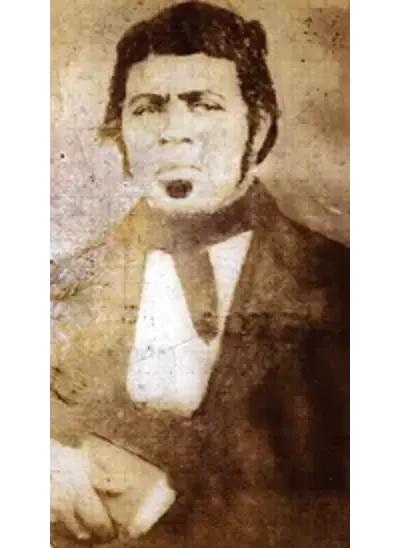
Paul Jennings (1799–1874) was an American personal servant, as a young enslaved man, to President James Madison during and after his White House years. After buying his freedom in 1845 from Daniel Webster, Jennings is noted for publishing in 1865 the first White House memoir. His book was A Colored Man's Reminiscences of James Madison, described as "a singular document in the history of slavery and the early American republic."
