Henry L. Dawes Quotes
… in all cases where any tribe or band of Indians has been, or shall hereafter be, located upon any reservation created for their use, … the President of the United States be, and he hereby is, authorized, whenever in his opinion any reservation or any part thereof of such Indians is advantageous for agricultural and grazing purposes, to cause said reservation, or any part thereof, to be surveyed, or resurveyed if necessary, and to allot the lands in said reservation in severalty to any Indian located thereon in quantities as follows: To each head of a family, one-quarter of a section [180 acres]; To each single person over eighteen years of age, one-eighth of a section [90 acres]; …
This law provided for Individual Indian ownership of land which was seen as an essential step to stimulate assimilation of Indians into American society. For some it had that effect, but it also weakened the tribal community as the allotted land was then no longer controlled communality by the tribe and civil governance of the allotted lands were transferred to the state and local government and away from the traditional tribal government. In some cases traditional tribal government became impossible. Also, the Indians who were allotted the land could and often did sell it to whites. Land owned by Indians decreased from 138 million acres in 1887 to 48 million acres in 1934—a 65 percent reduction. This Act also imposed a patriarchal household onto many matrilineal Native societies, in which women had controlled property and descent, since under the sexist American law at that time all family property was owned and controlled by the husband. In 1934 President Franklin Delano Roosevelt supported the US Indian Reorganization Act. It ended allotment and created a "New Deal" for Indians, including renewing their rights to reorganize and form their own governments. Much of the damage of the Dawes Act had already been done however. See Senator Henry Moore Teller’s criticism of the Dawes Act {633120}.
Henry L. Dawes, 1816-1903, U. S. Congressman & U. S. Senator (Republican, MA), The Dawes Act, February, 8, 1887
Sourced by: Eigen's Political and Historical Quotations

See {633119} for the basic provision of the Dawes Act.

By 1887 the government behavior towards Indians had come far from the Andrew Jackson days of Indian Removal and the government and reformers were trying to do better with Indian policy. This law was very well intended, and yet angered some Indians and tribes Where there was good agricultural or grazing land, the law required that the land be divided amongst the individual Indians who would thereafter own the deed and control the land. The problem had been that there was no concept of individual land ownership in most tribes. There were no deeds and whites would buy land unknowingly (and sometime knowingly who claimed to (or did) speak for the tribe. With this law, farm and grazing land would pass to the ownership of individual Indians. There are over 500 different Indian tribes—nations in America and they are very diverse. This law was good for some tribes and negative for others. With no communal say in the use of the land, the reservation was like a white farming community where the individual was dominant and not the town, group or culture. It minimized the dependency that Indians had on each other and the group. Within individual tribes there were often those Indians who preferred collective ownership and those who preferred individual ownership as provided in this legislation.


The reason for the secrecy was that he was informing Congress of the Lewis & Clark Expedition. Potentially, the Spanish, English or French might try to interfere with the expedition which was the precursor to American domination of the entire continent. Unfortunately, Jefferson’s plan for the Indians was not supported by many other Americans with the exception of New York State and the Iroquois remaining after many left after supporting the British in the Revolution. But the Iroquois who remained were already farmers in fixed communities and were experienced traders. Further, they had a complex governmental structure with many elements of democracy, and several had already succeeded in European educational settings. Their successful integration with the rest of New York can be demonstrated by the fact that New York is the only state where the average Native American Income is the same as the average white income, and there is no Indian gaming in New York. Jefferson’s vision, unfortunately, was never implemented in early the Westward Expansion.

President Jackson was the most extreme President in terms of abuse of Native American Rights. His racist views and policies were a large reason for the continuing problems that Indians have had gaining fair treatment and equality. Jackson was the only American President who ever refused to obey a Supreme Court decision when he removed the Cherokee Indians from their lands, despite the fact that the Supreme Court had ruled that such a removal was illegal. See {623405} for other Jackson views on Indian policy.

The Indians did not have the wheel when the whites came, but soon there were wagons, stage coaches and railroads.

This is an important quotations for two reasons. First, one of the white Europan myths in the colonial era was that the Native America had not concept of land ownership and title. This quotation clearly refutes that/ Second, this shows that some Europeans coming to the new world opposed the view that the white Christians and a moral right to the Native American “heathen” land. A few like Williams did not.


In early America large numbers of whites who had been captured by Indians would refuse to leave their new families even when they had the opportunity to do so. J. Hector St. John


Commenting on the status of the Cherokee Indians.


Use included renting it. What he opposed was simply holding land when whites were driving Indians off their lands because all the unused land outside of the reservation was owned by someone and the asking price was very high. Ingersoll was considered to be the greatest orator and political thinker of his day, but his overt atheistic views curtailed his elected political career.


In his honor, there have been no more Comanche chiefs selected. Leaders after Parker have had the title of Chairman. Parker is sometimes referred to as “the last Comanche chief.”

Many American leaders wanted to comply with and enforce the Indian treaties, but the remoteness made it difficult. There were always those whites who did not want to be restricted by Indian treaties who took advantage of the situation when there was a leader like Clinton who wanted to enforce the treaties. However in many cases, the American leadership really did not want to enforce the treaties and in some cases, as with President Andrew Jackson, wanted to abrogate the treaties with the Indians.

Paine, one of America’s founding fathers and the man most responsible for influencing Americans to revolt, is generally not given much attention in modern times. One of the main reasons was that his philosophy regarding land and land ownership is today considered socialist if not communist. Paine’s other views are mostly Apple pie American, but this is shocking to many Americans.
More and more whites had been encroaching on land of the Chickasaw Reservation which the United States was bound to protect. However, soldiers fighting whites was politically unpalatable and the Government came up with the idea of providing land West of the Mississippi as a new reservation in exchange for the existing reservation. The Indians expenses of moving would be paid and they would be given generous provisions in the new lands. The U. S. negotiators were surprised when the translator for the Chickasaw negotiators made this speech which was then reported to the President and Congress. Andrew Jackson was strongly in favor of Indian Removal and he had forced other tribes out of their lands. Eventually the Government upped the ante and agreed to pay the Chickasaw the large sum of $3 million to move and they Chickasaw realized that if they did not accept, they would be removed as other tribes had been, The promised payment was delayed over Congressional arguments over appropriations but eventually the Chickasaw were paid.

Note that there was still a serious attempt to coexist with the Indians and to pay for lands that whites moved into. This would change radically in the administration of Andrew Jackson who would replace Adams.
The century to which he was referring was the 19th century---1800-1899.

Samuel Langhorne Clemens, 1835-1910. Twain was one of the few whites who realized that success in assimilating American Indians would destroy their culture and identity. Even today, whites and Indians alike constantly debate the desirability of assimilation policies and supporting independent reservations.
The Iroquois were among the most sophisticated of the North American Indian Tribes. They also were highly assimilated into the American society. In the next decades, they would switch their political position when New York State provided better legal guarantees for Iroquois land than the Federal Government. By the end of the 20th Century, led by the Iroquois, the Indian residents of New York State had the same level of earnings as the white man—and that was with NO INDIAN GAMING.

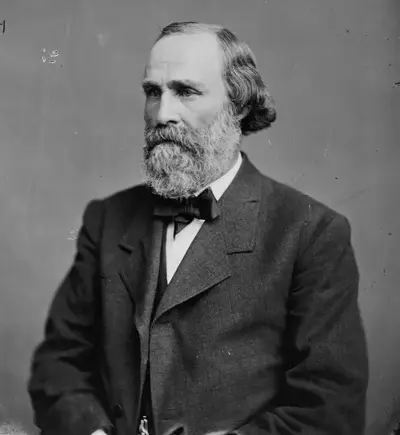
- Born: October 30, 1816
- Died: February 5, 1903
- Nationality:
- Profession:
Henry Laurens Dawes was an attorney and politician, a Republican United States Senator and United States Representative from Massachusetts. He is notable for the Dawes Act (1887), which was intended to stimulate the assimilation of Native Americans by ending the tribal government and control of communal lands. Especially directed at the tribes in Indian Territory, it provided for the allotment of tribal lands to individual households of tribal members, and for their being granted United States citizenship. This also made them subject to state and federal taxes. In addition, extinguishing tribal land claims in this territory later enabled the admission of Oklahoma as a state in 1907.
