David Frum Quotes
If you want to do spending austerity, single payer [for health insurance] is a powerful tool.
A single payer system for health insurance saves an enormous amount of money—15 to 20 percent of all health payments made under all health insurance. However, this quotation from a leading Republican disclosed a split in the Republican Party. Many really would like the many billions of dollars that would be saved every year by having one organization pay all health insurance bills as Medicare did, but the large insurance companies, major contributors to Republicans, of course did not want to compete for the single payer where most would lose their administrative overhead and profits from the existing inefficient system. So austerity, normally a strong Republican principle, gave way to the profits of an important Republican contributor base.
David Frum, Republican Presidential Speech Write, Canadian & American Political Columnist, Quoted in Josh Barro,, “Conservatives Fall in Love With Canada”, New York Times, September 21, 2014
Sourced by: Eigen's Political and Historical Quotations


The Republicans were trying to repeal the first national health reform since Medicare. But the part was split over what they would replace it with. Many wanted to give the health insurers more power and profits, but other Republicans like Cruz did not want to see the helath insurance premiums increase. Ironically, most members of Congress at the time agreed with Cruz's focus on lowering or at least holding health insurance premiums steady, but this was vert hard to do without heavily regulating the insurance companies or adding a public insurance program to compete with the insurance companies or eliminate the rights of the individual states to regualte and control; insurance in their state. And no majority could be found for any of these.


Unlike most forms of insurance virtually everyone will have one or more claims and collect in his or her lifetime. Many of use will never have an automobile crash and collect on our insurance policy, but health is different in that we all change health status from well to ill at times and if we are fortunate we return to a state of wellness. But as Eigen observes, most of us who are tell are only temporarily well, With time our state will change to ill and if we are not very fortunate we will never use our health insurance as we will be dead. There is almost no way to age in a modern society without needing health care or funeral services, That is the consequence of the normal process of aging. So with health insurance schemes we, in effect, pass money from the living well to the living ill. So if health care costs increase fastr than inflation, which it has almost always done in the last half century, the temporarily well will be paying more and more. The only way to break that cycle is to somehow limit the cost increases of health care to that of the inflationary increase. Eigen has argued that most of us focus on the wrong problem--the details of the way the well pay for the ill, when the only soltuion is to reduce the rate of increases of health care costs. And there are only 2 ways to do that: Reduce the compensation for all the health care actors--physicians, nurses, other staff, hospitals, and manufacturers of medical equipment, supplies and expecially pharmaceuticals which have been increasing at the fastest rate of all or wer privide more and more effective prevention.


That particular Libertarian platform called for the abolition / repeal of Social Security, Medicare, Medicaid, the Post Office, Federal election Commission and campaign finance laws. Extreme radical ideas such as this are not typical of Libertarian Party positions before or afterwards. The quotation illustrates that there are people in America who would end public education if they could. The quotation also illustrates how a small cadre of people can capture control of a political party and create a platform that is their own personal views which may be different from most of the party members or the historical position that the party has taken. In 1980 the Libertarian Party Vice Presidential Candidate was David Koch, one half of the billionaire conservative Koch brothers. Their money financed the Libertarian Party in that year and David Koch’s views then prevailed in the party platform. Historically, the Koch brothers moved from a minor third party to the Republican party at the beginning of the 21st century when their money was able to help drive the party very far to the right from the traditions of Abraham Lincoln and Theodore Roosevelt.

At the time in America, the insurance companies only paid out less than 80 percent of all the money they took in for health insurance. More than 20 percent went into their high overhead and profits. In contrast, to the 20 percent or more that it costs with insurance companies to administer health insurance payments, the agency that performs the same function for Medicare doe so with only a 6 percent cost Sanders argued that by getting rid of the insurance companies, the nation could save about 14 percent of the entire insured medical bills for the nation—many billions of dollars which would reduce average health insurance premiums by 14 percent. Opponents argue that the would be a socialist system and give too much potential control of individual health matters to a government operated or government controlled organizations. Politicians, in order to look good with the voters, would lower premiums and also pay out less either shortchanging doctors and hospitals or rating medial care somehow.


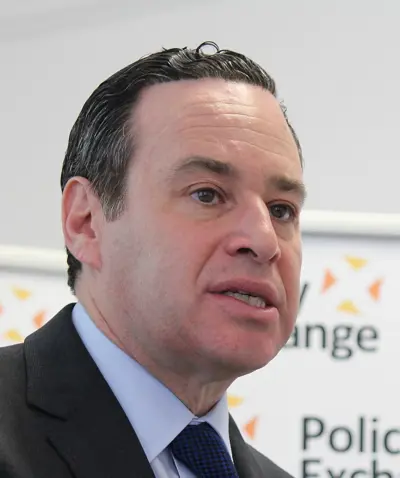
David Jeffrey Frum is a Canadian-American political commentator and a former speechwriter for President George W. Bush, who is currently a senior editor at The Atlantic as well as an MSNBC contributor. In 2003, Frum authored the first book about Bush's presidency written by a former member of the administration. He has taken credit for inspiring the phrase "axis of evil" in Bush's 2002 State of the Union address.
