Atal Bihari Vajpayee Quotes
If Pakistan claims to be a crucial partner in the international coalition against terrorism, how can it continue to use terrorism as an instrument of state policy against India?
Vajpayee, Atal Bihari. "Address at the 57th Session of the UN General Assembly." United Nations, 13 Sept. 2002.

Pakistan and India have been at odds over Kashmir and other issues ever since British India was partitioned into the two states. There have been constant Pakistan incursions into India many of which are classic examples of terrorism. The Pakistani Prime Ministers and Presidents have maintained that this is against their policy and that the terrorists are beyond the control of the government. However, many of the other politicians and Muslim religious leaders advocate terrorism against India as part of Jihad. Even elements of the Pakistani military intelligence units have supported the terrorists. However, the Pakistan government has after September 11 have been very helpful against the many terrorists in Pakistan but they have been unable to control the many Islamic fundamentalists calling for jihad.


The 10th Amendment reserves powers to the states and limits the Federal Government’s powers. However, there are other clauses in the Constitution, like the Commerce Clause (Article I Section 8), which gives the Federal Government authority and control over Interstate Commerce, which in modern society permeates almost all activities of State government, The result is that the federal government / state government power division has been a political issue and not really a constitutional one. At the time Republicans advocated a literal 10th Amendment interpretation and the Democrats favored a stronger Federal Government with more authority and power as stated by the Commerce Clause. Roy had been trying to explain to his fellow Republican strategists that it is hard to attract Blacks to the remainder to the Republican Platform as long as they were insensitive to what the 10th Amendment meant to Blacks historically. The Southern states cited the 10th Amendment more than any other part of the constitution to justify their right to maintain slavery. It was the Federal Government that ended slavery. Under the rubric of the 10th Amendment the South managed to get rid of most of the racial civil rights Reconstruction reforms that were imposed by the Federal Government on the Southern States. And it was the 19th Amendment that was the authority for Segregation for 100 years. And the terrorism of the Klu Klux Klan and the lynching and terror imposed on Blacks by Southern states claiming the 10th Amendment right to do so. Finally, it was the Federal Government, overriding the 10th Amendment with the Commerce Clause and other parts of the Constitution that passed and enforced the Civil Rights Act, the Voting Rights Act, Desegregation and the end to Lynching and other Southern State-Sponsored terrorism. Blacks will not any time soon accede to having the 10th Amendment literal view of the role of government and if Republicans insist on that there would continue to be very few Black Republicans,


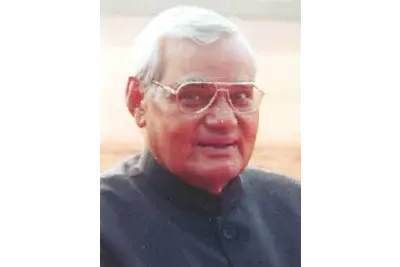
Atal Bihari Vajpayee was an Indian statesman who served three terms as the Prime Minister of India, first for a term of 13 days in 1996, then for a period of 13 months from 1998 to 1999, followed by a full term from 1999 to 2004. Vajpayee was one of the co-founders and a senior leader of the Bharatiya Janata Party (BJP). He was a member of the Rashtriya Swayamsevak Sangh, a Hindu nationalist volunteer organisation. He was the first Indian prime minister not of the Indian National Congress to serve a full term in office. He was also noted as a poet and a writer.
