John Keats Quotes
I would jump down Etna for any public good - but I hate a mawkish popularity.
Keats, John. The Letters of John Keats, 1814-1821, Volume 1. Edited by Hyder Edward Rollins, Harvard University Press, 1958, p. 267.


In one of the most unusual revolutions in world history, Brazil became independent from Portugal via a revolution led by the son of the Portuguese King and heir to the throne, Pedro I. The crown prince of Portugal, led Brazil in her breakaway from Portugal and by popular acclaim became Pedro I, Emperor of Brazil. He is probably the only monarch in history who was the heredity monarch of one kingdom and selected by popular acclaim to the throne of another.

This may be Kennedy’s most famous line. However he was not the first orator to express this idea however. See Khalil Gibran {601423}, Warren G. Harding {622594} and {629021}, St. John Broderick {595734}, and Oliver Wendell Holmes Jr. {603707} for earlier expressions of similar sentiments. Holmes seems to be the first to express the idea while the earliest seems similar phraseology seems to be the British Politician St. John Broderick in 1893 {595734}. Although, these earlier expressions existed, Theodore C. Sorensen, who assisted Kennedy with this speech and wrote the draft, had distilled it from earlier expressions and views of JFK and said that these were Kennedy’s words. At the time, he stated that was unaware of the Gibran, Harding, Broderick and Holmes sentiments. Gibran had not yet even been translated into English. However it is not clear whether Kennedy himself had inadvertently recollected the phrase from any of the other quotations. (The question was never put to him.) The St. John Broderick quotation is a possible source. Kennedy was quite familiar with British political history, and his father and been U. S. Ambassador to Great Britain. Regardless, the quotation was as great for the place and timing—his inaugural—as it was for the phraseology which might have originated elsewhere.


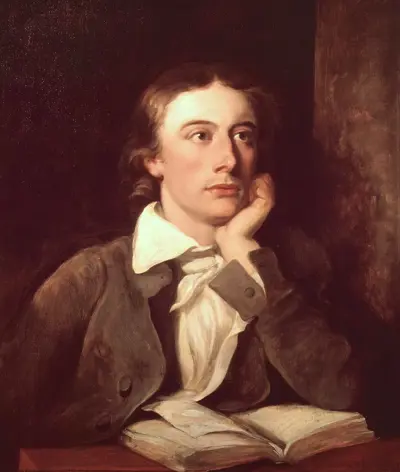
John Keats was an English Romantic poet. He was prominent in the second generation of Romantic poets, with Lord Byron and Percy Bysshe Shelley, though his poems were in publication for only four years before he died of tuberculosis at the age of 25. They were not generally well received by critics in his lifetime, but his fame grew after his death, and by the end of the century he had become one of the best beloved English poets, with a strong influence on many writers. Jorge Luis Borges called his first encounter with Keats' work an experience that he felt all of his life. It had a style "heavily loaded with sensualities", notably in the series of odes. It was typical of the Romantics to accentuate extreme emotion through emphasis on natural imagery. Today his poems and letters remain among the most popular and analysed in English literature. Especially acclaimed are "Ode to a Nightingale", "Sleep and Poetry" and the famous sonnet "On First Looking into Chapman's Homer".
