Florence Welch Quotes
I was having a conversation with my father and he was talking about this thing - strangeness and charm. It's actually the name of the two smallest particles that there are when you split the atom, so I wrote a song around it. I even managed to fit the word 'hydrogen' in there. Isn't that a nice thing for scientists to call them though?
Welch, Florence. Interview by John Kennedy. X-Posure, Radio X, 2010.


This quotation illustrates a facet of science that often affects politics. At the time there had been much new information that tended to give more and more support to the notion of the atom. Most physics were by then convinced that there were atoms and that they seemed to behave just like Newton’s laws predicted that all bodies would. Mach however, would not even accept the fact that atoms really existed. He was not just any scientist but one of the better and more prestigious physicists in the world. New ideas are rarely accepted by all, even in the scientific disciplines. In the late 20th century scientific evidence began to be amassed indicating that there was global warming and a significant part of it was man made. As the data kept accumulating and the results of studies were understood, the vast majority of scientists became convinced about global warming. But there were a few who did not think that there was yet sufficient evidence to reach that conclusion, just as Mach was in 1897 convinced that there the atoms existence had not been demonstrated and in his judgment he did not think that atoms were a reasonable explanation of the physical world. But the fact that he had not yet become convinced should be examined by policy makers and juxtaposed against the reasons and the evidence by the other scientists. He might have been right; however he was not. The global warming nay sayers might be right, but with each passing day, the likelihood becomes less as more evidence is aggregated and analyzed.


This is one of the most momentous quotations of all time. Otto Hahn was a German Chemist who until recently had worked with Lisa Meitner in one of the most productive scientific collaborations of all time. However, Meitner was Jewish and had to flee from Germany with Hahn’s help for her life. She went to Stockholm where they were doing almost no nuclear research and although she was a famous physicist, there was no laboratory or university that could use her talents, thus her term “empty handed”. She and Hahn had conducted a series of experiments bombarding radioactive material with particles which transmuted the radioactive element to another element nearby on the Periodic Table of the elements—an element with a close atomic number. After Meitner escaped, Hahn with Fritz Strassmann assisting, bombarded uranium the heaviest element with neutrons, the heaviest particles. However, in addition to the expected results, a substantial amount of Barium remained after the bombardment. Hahn was a brilliant experimental chemist and at first he assumed that perhaps they had identified the Barium erroneously or the data was read incorrectly, or the experiment had been contaminated. There was no explanation for it. So he sent copies of all the data to Meitner a brilliant Physicist and Mathematician who was the theoretician of their team. She studied the data with her nephew, Otto Frisch who was a young up and coming mathematician. After a few days, she had figured it out. Hahn had produced the first human induced case of nuclear fission although they gave it that name a little later. She and her nephew confirmed all the data readings mathematically and proved exactly what had happened. She refers to it in the letter as “splitting” the atom. She wrote to Hahn and explained what had happened. Without any intention of doing so, he and Strassmann were the first scientists to create a real example of nuclear fission. The world has never been the same since. Hahn and Strassmann were awarded the Nobel Prize.
Meitner and her nephew Frisch had been the first people to realize that the atom had been split. Meitner had described the process to her nephew and he made some drawings of the process she described. A few of these looked like a bacteria dividing. Frisch happened to meet with William A. Arnold, an American Biologist doing research in Stockholm. He asked Arnold what the biologists called it when a bacteria divided, and he replied, “fission”. Frisch told his aunt and she decided that they should use that term in the scientific article they were preparing on the splitting of the atom.


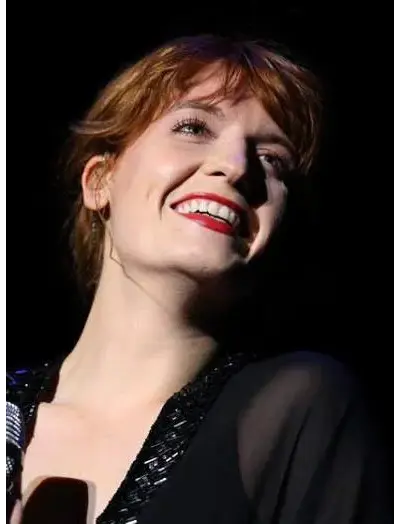
Florence Leontine Mary Welch is an English singer, the lead vocalist and primary songwriter of the indie rock band Florence and the Machine. The band's debut studio album, Lungs topped the UK Albums Chart after charting for 28 consecutive weeks, and won the BRIT Award for Best British Album. The band's second album, Ceremonials (2011), debuted at number one in the UK and number six on the US Billboard 200. Their third album, How Big, How Blue, How Beautiful (2015) received positive reviews and topped the UK and US albums chart. The band's fourth album, High as Hope, was released in June 2018 and has sold over one million copies worldwide.
