I. M. Pei Quotes
I was born in Suzhou, a city not very far from Shanghai. It's a very interesting town - there is a long artist's tradition there, especially during the Ming and Ching dynasties, which produced many, many scholars and painters and so forth. That's where my family lived for 600, 700 years.
Pei, I. M. "I. M. Pei Interview." Academy of Achievement, American Academy of Achievement, 25 May 2000.


Crocker’s railroad was way behind schedule for laying of track. The problem was an acute shortage of manpower. Someone suggested that they try Chinese labor. However Crocker’s superintendent of construction, James Strobridge, felt that they were too small, not strong enough, and inexperienced at construction. Soon Crocker had 11,000 Chinese workers. The Chinese were wonderful construction workers and the Southern Pacific Railroad thrived as other employers also began using Chinese workers.


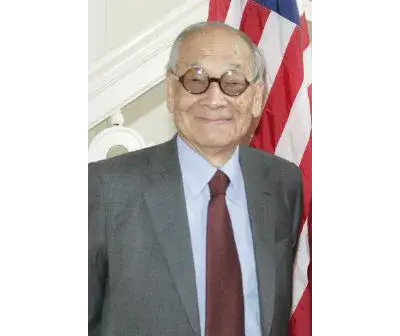
Ieoh Ming Pei, FAIA, RIBA was a Chinese-American architect. Born in Guangzhou, raised in Hong Kong and Shanghai, Pei drew inspiration at an early age from the garden villas at Suzhou, the traditional retreat of the scholar-gentry to which his family belonged. In 1935, he moved to the United States and enrolled in the University of Pennsylvania's architecture school, but he quickly transferred to the Massachusetts Institute of Technology. He was unhappy with the focus at both schools on Beaux-Arts architecture, and spent his free time researching emerging architects, especially Le Corbusier. After graduating, he joined the Harvard Graduate School of Design (GSD) and became a friend of the Bauhaus architects Walter Gropius and Marcel Breuer. In 1948, Pei was recruited by New York City real estate magnate William Zeckendorf, for whom he worked for seven years before establishing an independent design firm in 1955, I. M. Pei & Associates. In 1966 that became I. M. Pei & Partners, and in 1989 became Pei Cobb Freed & Partners. Pei retired from full-time practice in 1990. In his retirement, he worked as an architectural consultant primarily from his sons' architectural firm Pei Partnership Architects.
