Robert Scheer Quotes
I was able to do something that people can't do these days, which is to have quality time with the guys who were trying to be president and a number of them who got the job.
Scheer, Robert. Interview with Brian Lamb. Q&A, C-SPAN, 28 May 2006.


In many recent Presidential elections many have thought a Vice Presidential candidate superior to the Presidential candidate. Such was also the case in 1900.


In 1877 Wasburn was dropped from the List of Ministers by the Unitarian Church. He had become very critical of organized and orthodox religion of all kinds.

In 2012, the Republican party had shifted to the right and was split between two factions. None of the 4 leading candidates had the support of a majority of the activist Republicans who vote in Primary elections. The then started to vie with each other for the most conservative elements of the party and did so by attacking the other candidates, making moral pronouncements and attacking President Obama. None of them offered any positive programs or solutions to the problems they claimed existed, and the attacks on the others were always that they were “really not conservative” and “could not get elected.” The result was that all the candidates negatives rose.

In 2011 and 2012, there were several candidates vying for the Republican Nomination for the Presidency. The contest was close, and the candidates unleashed on each other the negative advertising and outrageously false accusations which they had previously only reserved to attack Democrats. They were so good at it, that they all drove up each others’ negatives—so much so that the potential Republican Candidate would be permanently scarred in the minds of the public. More mature and senior Republicans like McCain urged an end to the face to face confrontations of debates.

The three richest men in America—John D, Rockefeller, Andrew Carnegie, and Morgan, usually major rivals—had gathered together to decide what to do about William Jennings Bryan, who they viewed as very hostile to business and capitalism. (See {641037} and {641038} for Bryan quotation examples that concerned them.) They agreed to combine their efforts and back William McKinley who was running for the Republican Presidential nomination. In those days, the nominee was chosen by a small group of party leaders and their resources guaranteed McKinley the post. They then put large amounts of money to campaigning against Bryan and for McKinley including dirty tricks, many of which are illegal today. It is not known for certain whether McKinley knew the extent of the involvement of the monopolists, but shortly after assuming the Presidency he cut back on many of the relatively few regulations that then existed to control unbridled capitalism. Their effort went for naught when McKinley was assassinated and Theodore Roosevelt became President. Roosevelt would not be bribed or intimidated, and he did more to control monopolies than even Bryan would likely have.

In Iowa they have a caucus primary system, which is very foreign to most politicians.

Questioning the wisdom of the then existing system of selecting major party presidential candidates by primary elections where even few party members vote.


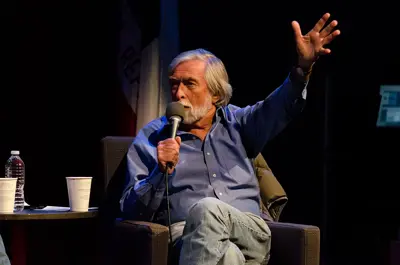
Robert Scheer is an American journalist who has written for Ramparts, the Los Angeles Times, Playboy, Truthdig, Scheerpost and other publications as well as having written many books. His column for Truthdig was nationally syndicated by Creators Syndicate in publications such as The Huffington Post and The Nation. He is a clinical professor of communications at the Annenberg School for Communication & Journalism at the University of Southern California. Scheer is the former editor in-chief for the Webby Award-winning online magazine Truthdig. For many years, he co-hosted the nationally syndicated political analysis radio program Left, Right & Center on National Public Radio (NPR), produced at public radio station KCRW in Santa Monica. The Society of Professional Journalists awarded Scheer the 2011 Sigma Delta Chi Award for his column.
