William Smyth Quotes
I hold to be of itself a lesson for all those who love liberty, and who would extend its blessings to their country. Men are not to be pedants in liberty, any more than in virtue. Though they are not to be oppressed by tyrants, they must at least be governed by their fellow-men. The great principles of independence in the heart of man are to be cherished and upheld; but order, prosperity, the purposes of society, must be accomplished. The many must delegate the government of themselves to the few. Control, executive power, must be lodged somewhere …
William Smyth, 1765–1849, English Historian, Lectures on Modern History, published 1854
Sourced by: Eigen's Political and Historical Quotations


This quotation is a great demonstration of how much wiser and the better politician of all the crowned heads of Europe that Queen Victoria was. There were stirrings of freedom and desire for parliamentary government throughout Europe. Queen Victoria, even though and perhaps because she was a young woman, had a great feel for fairness and reasonableness and had read a great deal of history. There were some radical red socialists calling for complete radical revolution scaring European Royalty profoundly. They reacted very conservatively and with reaction, reverting to more tyrannical practices of the past urged in that path by very conservative, right wing advisors. Victoria also had little respect for some of the monarchs who had little interest in their people and much with their personal power and wealth. In the end, it was England which was the only nation which never had a serious radical socialist / communist threat, and that had much to do with Victoria’s political acumen and wisdom.


Harding was arguing for party government. He may or may not have been right, but he was one of the weaker administers that held the American presidency. In addition he was not a particularly hard worker, and was more than willing to share any burdens.

The government relationship to people phrase, although probably Lincoln's most famous, was not totally original. John Adams came close in a 1774 proclamation. As did John Marshall in his McCulloch v. Maryland decision. Daniel Webster's Speech on Foot's Resolution was very close. as was Theodore Parker in 1850 {629578}. There was also Thomas Cooper in 1795. But the earliest appears to be John Wycliffe in 1382 {567292}. It is not known with which of these Lincoln was familiar.


For that, the Church burned him at the stake. Note the phraseology and compare it to Gettysburg Address {458852}. It is not known whether Lincoln was aware of this quotation or others that used similar wording.


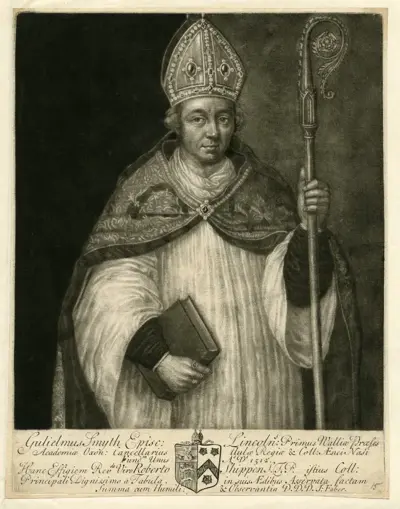
William Smyth (or Smith) was Bishop of Coventry and Lichfield from 1493 to 1496 and then Bishop of Lincoln until his death. He held political offices, the most important being Lord President of the Council of Wales and the Marches. He became very wealthy and was a benefactor of a number of institutions. He was a co-founder of Brasenose College, Oxford and endowed a grammar school in the village of his birth in Lancashire.
